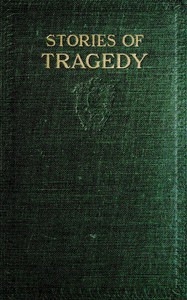
Stories of Tragedy — Text and Context

(5 User reviews)   1060
Johnson, Rossiter, 1840-1931 [Editor] Project Gutenberg 2019 Not confirmed
Fiction; Short stories; Literature -- Collections Readers of public-domain and historical texts
Project Gutenberg digital edition en

Edition facts

Words 59,085
Reading time 257 min
Text sections 6

The catalog record for Stories of Tragedy — Text and Context provides practical reading context through 59,085 words, 4 hr 17 min estimated reading time, and 6 detected text sections.

The text analysis averages about 21.1 words per sentence, while the detected sections provide another way to judge how the source is divided.

Project Gutenberg metadata also associates the work with “Fiction,” connecting these edition facts with the source record’s subject description.

An 1874 anthology of seven tragic tales, including Poe's 'The Murders in the Rue Morgue' and Melville's 'The Bell-Tower,' edited by Rossiter Johnson. The collection showcases varied approaches to tragedy, from analytical detection to psychological horror and moral allegory, unified by recurring motifs of confinement, sudden reversal, and the limits of human reason.
Share
Editorial Edition Score 4.7/5

Calculated from edition completeness, EPUB availability, text structure and catalogue metadata. Not a user rating.

How this score is calculated
  • Description quality20 pts
  • Title & short description10 pts
  • Source metadata20 pts
  • Text length15 pts
  • Chapters / structure15 pts
  • EPUB file integrity20 pts

Total of 100 points, scaled to a 2.5-5.0 range. Editions with an empty description or a missing EPUB file are not scored.

Edition quality

Read the Text

result of an excited, or perhaps of a diseased intelligence. But of the character of his remarks at the periods in question an example will best convey the idea.

We were strolling one night down a long dirty street, in the vicinity of the Palais Royal. Being both, apparently, occupied with thought, neither of us had spoken a syllable for fifteen minutes at least. All at once Dupin broke forth with these words:—

“He is a very little fellow, that’s true, and would do better for the _Théâtre des Variétés_.”

“There can be no doubt of that,” I replied unwittingly, and not at first observing (so much had I been absorbed in reflection) the extraordinary manner in which the speaker had chimed in with my meditations. In an instant afterward I recollected myself, and my astonishment was profound.

“Dupin,” said I, gravely, “this is beyond my comprehension. I do not hesitate to say that I am amazed, and can scarcely credit my senses. How was it possible you should know I was thinking of—” Here I paused, to ascertain beyond a doubt whether he really knew of whom I thought.

—“of Chantilly,” said he; “why do you pause? You were remarking to yourself that his diminutive figure unfitted him for tragedy.”

This was precisely what had formed the subject of my reflections. Chantilly was a _quondam_ cobbler of the Rue St. Denis, who, becoming stage-mad, had attempted the _rôle_ of Xerxes, in Crébillon’s tragedy so called, and been notoriously Pasquinaded for his pains.

“Tell me, for Heaven’s sake,” I exclaimed, “the method—if method there is—by which you have been enabled to fathom my soul in this matter.” In fact, I was even more startled than I would have been willing to express.

“It was the fruiterer,” replied my friend, “who brought you to the conclusion that the mender of soles was not of sufficient height for Xerxes _et id genus omne_.”

“The fruiterer!—you astonish me,—I know no fruiterer whomsoever.”

“The man who ran up against you as we entered the street: it may have been fifteen minutes ago.”

I now remembered that, in fact, a fruiterer, carrying upon his head a large basket of apples, had nearly thrown me down, by accident, as we passed from the Rue C—— into the thoroughfare where we stood; but what this had to do with Chantilly I could not possibly understand.

There was not a particle of _charlatânerie_ about Dupin. “I will explain,” he said, “and that you may comprehend all clearly, we will first retrace the course of your meditations, from the moment in which I spoke to you until that of the _rencontre_ with the fruiterer in question. The larger links of the chain run thus,—Chantilly, Orion, Dr. Nichols, Epicurus, stereotomy, the street stones, the fruiterer.”

There are few persons who have not, at some period of their lives, amused themselves in retracing the steps by which particular conclusions of their own minds have been attained. The occupation is often full of interest; and he who attempts it for the first time is astonished by the apparently illimitable distance and incoherence between the starting-point and the goal. What, then, must have been my amazement when I heard the Frenchman speak what he had just spoken, and when I could not help acknowledging that he had spoken the truth! He continued:—

“We had been talking of horses, if I remember aright, just before leaving the Rue C——. This was the last subject we discussed. As we crossed into this street, a fruiterer, with a large basket upon his head, brushing quickly past us, thrust you upon a pile of paving-stones collected at a spot where the causeway is undergoing repair. You stepped upon one of the loose fragments, slipped, slightly strained your ankle, appeared vexed or sulky, muttered a few words, turned to look at the pile, and then proceeded in silence. I was not particularly attentive to what you did; but observation has become with me, of late, a species of necessity.

“You kept your eyes upon the ground,—glancing, with a petulant expression, at the holes and ruts in the pavement (so that I saw you were still thinking of the stones), until we reached the little alley called Lamartine, which has been paved, by way of experiment, with the overlapping and riveted blocks. Here your countenance brightened up, and perceiving your lips move, I could not doubt that you murmured the word ‘stereotomy,’ a term very affectedly applied to this species of pavement. I knew that you could not say to yourself ‘stereotomy,’ without being brought to think of atomies, and thus of the theories of Epicurus; and since, when we discussed this subject not very long ago, I mentioned to you how singularly, yet with how little notice, the vague guesses of that noble Greek had met with confirmation in the late nebular cosmogony, I felt that you could not avoid casting your eyes upward to the great _nebula_ in Orion, and I certainly expected that you would do so. You did look up; and I was now assured that I had correctly followed your steps. But in that bitter _tirade_ upon Chantilly, which appeared in yesterday’s _Musée_, the satirist, making some disgraceful allusions to the cobbler’s change of name upon assuming the buskin, quoted a Latin line about which we have often conversed. I mean the line,

‘Perdidit antiquum litera prima sonum.’

I had told you that this was in reference to Orion, formerly written Urion; and, from certain pungencies connected with this explanation, I was aware that you could not have forgotten it. It was clear, therefore, that you would not fail to combine the two ideas of Orion and Chantilly. That you did combine them I saw by the character of the smile which passed over your lips. You thought of the poor cobbler’s immolation. So far, you had been stooping in your gait; but now I saw you draw yourself up to your full height. I was then sure that you reflected upon the diminutive figure of Chantilly. At this point I interrupted your meditations to remark that as, in fact, he _was_ a very little fellow,—that Chantilly,—he would do better at the _Théâtre des Variétés_.”

Not long after this, we were looking over an evening edition of the _Gazette des Tribunaux_, when the following paragraphs arrested our attention:—

“EXTRAORDINARY MURDERS.—This morning, about three o’clock, the inhabitants of the Quartier St. Roch were aroused from sleep by a succession of terrific shrieks, issuing, apparently, from the fourth story of a house in the Rue Morgue, known to be in the sole occupancy of one Madame L’Espanaye, and her daughter, Mademoiselle Camille L’Espanaye. After some delay, occasioned by a fruitless attempt to procure admission in the usual manner, the gateway was broken in with a crow-bar, and eight or ten of the neighbors entered, accompanied by two _gendarmes_. By this time the cries had ceased; but, as the party rushed up the first flight of stairs, two or more rough voices, in angry contention, were distinguished, and seemed to proceed from the upper part of the house. As the second landing was reached, these sounds, also, had ceased, and everything remained perfectly quiet. The party spread themselves, and hurried from room to room. Upon arriving at a large back chamber in the fourth story (the door of which, being found locked, with the key inside, was forced open), a spectacle presented itself which struck every one present not less with horror than with astonishment.

“The apartment was in the wildest disorder,—the furniture broken and thrown about in all directions. There was only one bedstead; and from this the bed had been removed, and thrown into the middle of the floor. On a chair lay a razor besmeared with blood. On the hearth were two or three long and thick tresses of gray human hair, also dabbled in blood, and seeming to have been pulled out by the roots. Upon the floor were found four Napoleons, an ear-ring of topaz, three large silver spoons, three smaller of _métal d’Alger_, and two bags, containing nearly four thousand francs in gold. The drawers of a bureau, which stood in one corner, were open, and had been, apparently, rifled, although many articles still remained in them. A small iron safe was discovered under the bed (not under the bedstead). It was open, with the key still in the door. It had no contents beyond a few old letters, and other papers of little consequence.

“Of Madame L’Espanaye no traces were here seen; but an unusual quantity of soot being observed in the fireplace, a search was made in the chimney, and (horrible to relate!) the corpse of the daughter, head downward, was dragged therefrom, it having been thus forced up the narrow aperture for a considerable distance. The body was quite warm. Upon examining it, many excoriations were perceived, no doubt occasioned by the violence with which it had been thrust up and disengaged. Upon the face were many severe scratches, and upon the throat dark bruises and deep indentations of finger-nails, as if the deceased had been throttled to death.

“After a thorough investigation of every portion of the house without further discovery, the party made its way into a small paved yard in the rear of the building, where lay the corpse of the old lady, with her throat so entirely cut that, upon an attempt to raise her, the head fell off. The body, as well as the head, was fearfully mutilated, the former so much so as scarcely to retain any semblance of humanity.

“To this horrible mystery there is not as yet, we believe, the slightest clew.”

The next day’s paper had these additional particulars:—

“THE TRAGEDY IN THE RUE MORGUE.—Many individuals have been examined in relation to this most extraordinary and frightful affair” [the word _affaire_ has not yet, in France, that levity of import which it conveys with us], “but nothing whatever has transpired to throw light upon it. We give below all the material testimony elicited.

“_Pauline Dubourg_, laundress, deposes that she has known both the deceased for three years, having washed for them during that period. The old lady and her daughter seemed on good terms,—very affectionate towards each other. They were excellent pay. Could not speak in regard to their mode or means of living. Believed that Madame L. told fortunes for a living. Was reputed to have money put by. Never met any persons in the house when she called for the clothes or took them home. Was sure that they had no servant in employ. There appeared to be no furniture in any part of the building, except in the fourth story.

“_Pierre Moreau_, tobacconist, deposes that he has been in the habit of selling small quantities of tobacco and snuff to Madame L’Espanaye for nearly four years. Was born in the neighborhood, and has always resided there. The deceased and her daughter had occupied the house in which the corpses were found for more than six years. It was formerly occupied by a jeweller, who under-let the upper rooms to various persons. The house was the property of Madame L. She became dissatisfied with the abuse of the premises by her tenant, and moved into them herself, refusing to let any portion. The old lady was childish. Witness had seen the daughter some five or six times during the six years. The two lived an exceedingly retired life,—were reputed to have money. Had heard it said among the neighbors that Madame L. told fortunes; did not believe it. Had never seen any person enter the door except the old lady and her daughter, a porter once or twice, and a physician some eight or ten times.

“Many other persons, neighbors, gave evidence to the same effect. No one was spoken of as frequenting the house. It was not known whether there were any living connections of Madame L. and her daughter. The shutters of the front windows were seldom opened. Those in the rear were always closed, with the exception of the large back room, fourth story. The house was a good house, not very old.

“_Isidore Musèt_, _gendarme_, deposes that he was called to the house about three o’clock in the morning, and found some twenty or thirty persons at the gateway, endeavoring to gain admittance. Forced it open, at length, with a bayonet,—not with a crow-bar. Had but little difficulty in getting it open, on account of its being a double or folding gate, and bolted neither at bottom nor top. The shrieks were continued until the gate was forced, and then suddenly ceased. They seemed to be screams of some person (or persons) in great agony; were loud and drawn out, not short and quick. Witness led the way up stairs. Upon reaching the first landing, heard two voices in loud and angry contention; the one a gruff voice, the other much shriller,—a very strange voice. Could distinguish some words of the former, which was that of a Frenchman. Was positive that it was not a woman’s voice. Could distinguish the words _sacré_ and _diable_. The shrill voice was that of a foreigner. Could not be sure whether it was the voice of a man or of a woman. Could not make out what was said, but believed the language to be Spanish. The state of the room and of the bodies was described by this witness as we described them yesterday.

“_Henri Duval_, a neighbor, and by trade a silversmith, deposes that he was one of the party who first entered the house. Corroborates the testimony of Musèt in general. As soon as they forced an entrance, they reclosed the door to keep out the crowd, which collected very fast, notwithstanding the lateness of the hour. The shrill voice, this witness thinks, was that of an Italian. Was certain it was not French. Could not be sure that it was a man’s voice. It might have been a woman’s. Was not acquainted with the Italian language. Could not distinguish the words, but was convinced by the intonation that the speaker was an Italian. Knew Madame L. and her daughter. Had conversed with both frequently. Was sure that the shrill voice was not that of either of the deceased.

“_—— Odenheimer_, _restaurateur_. This witness volunteered his testimony. Not speaking French, was examined through an interpreter. Is a native of Amsterdam. Was passing the house at the time of the shrieks. They lasted for several minutes,—probably ten. They were long and loud, very awful and distressing. Was one of those who entered the building. Corroborated the previous evidence in every respect but one. Was sure that the shrill voice was that of a man,—of a Frenchman. Could not distinguish the words uttered. They were loud and quick, unequal, spoken apparently in fear as well as in anger. The voice was harsh,—not so much shrill as harsh. Could not call it a shrill voice. The gruff voice said repeatedly, _sacré_, _diable_, and once _mon Dieu._

“_Jules Mignaud_, banker, of the firm of Mignaud et Fils, Rue Deloraine. Is the elder Mignaud. Madame L’Espanaye had some property. Had opened an account with his banking-house in the spring of the year —— (eight years previously). Made frequent deposits in small sums. Had checked for nothing until the third day before her death, when she took out in person the sum of 4,000 francs. This sum was paid in gold, and a clerk sent home with the money.

“_Adolphe Le Bon_, clerk to Mignaud et Fils, deposes that on the day in question, about noon, he accompanied Madame L’Espanaye to her residence with the 4,000 francs, put up in two bags. Upon the door being opened, Mademoiselle L. appeared, and took from his hands one of the bags, while the old lady relieved him of the other. He then bowed and departed. Did not see any person in the street at the time. It is a by-street, very lonely.

“_William Bird_, tailor, deposes that he was one of the party who entered the house. Is an Englishman. Has lived in Paris two years. Was one of the first to ascend the stairs. Heard the voices in contention. The gruff voice was that of a Frenchman. Could make out several words, but cannot now remember all. Heard distinctly _sacré_ and _mon Dieu_. There was a sound at the moment as if of several persons struggling,—a scraping and scuffling sound. The shrill voice was very loud,—louder than the gruff one. Is sure that it was not the voice of an Englishman. Appeared to be that of a German. Might have been a woman’s voice. Does not understand German.

“Four of the above-named witnesses, being recalled, deposed that the door of the chamber in which was found the body of Mademoiselle L. was locked on the inside when the party reached it. Everything was perfectly silent,—no groans or noises of any kind. Upon forcing the door no person was seen. The windows, both of the back and front room, were down, and firmly fastened from within. A door between the two rooms was closed, but not locked. The door leading from the front room into the passage was locked, with the key on the inside. A small room in the front of the house, on the fourth story, at the head of the passage, was open, the door being ajar. This room was crowded with old beds, boxes, and so forth. These were carefully removed and searched. There was not an inch of any portion of the house which was not carefully searched. Sweeps were sent up and down the chimneys. The house was a four-story one, with garrets (_mansardes_). A trap-door on the roof was nailed down very securely,—did not appear to have been opened for years. The time elapsing between the hearing of the voices in contention and the breaking open of the room door was variously stated by the witnesses. Some made it as short as three minutes, some as long as five. The door was opened with difficulty.

“_Alfonzo Garcio_, undertaker, deposes that he resides in the Rue Morgue. Is a native of Spain. Was one of the party who entered the house. Did not proceed up stairs. Is nervous, and was apprehensive of the consequences of agitation. Heard the voices in contention. The gruff voice was that of a Frenchman. Could not distinguish what was said. The shrill voice was that of an Englishman,—is sure of this. Does not understand the English language, but judges by the intonation.

“_Alberto Montani_, confectioner, deposes that he was among the first to ascend the stairs. Heard the voices in question. The gruff voice was that of a Frenchman. Distinguished several words. The speaker appeared to be expostulating. Could not make out the words of the shrill voice. Spoke quick and unevenly. Thinks it the voice of a Russian. Corroborates the general testimony. Is an Italian. Never conversed with a native of Russia.

“Several witnesses, recalled, here testified that the chimneys of all the rooms on the fourth story were too narrow to admit the passage of a human being. By ‘sweeps’ were meant cylindrical sweeping-brushes, such as are employed by those who clean chimneys. These brushes were passed up and down every flue in the house. There is no back passage by which any one could have descended while the party proceeded up stairs. The body of Mademoiselle L’Espanaye was so firmly wedged in the chimney that it could not be got down until four or five of the party united their strength.

Rossiter Johnson's 1874 collection Stories of Tragedy opens with Edgar Allan Poe's 'The Murders in the Rue Morgue,' a story that begins not with a corpse but with a meditation on analysis. The narrator distinguishes between chess and draughts, arguing that the latter better exercises 'the higher powers of the reflective intellect.' This prefatory move establishes a pattern across the volume: each tale approaches tragedy through a distinct structural lens. The anthology gathers seven works by authors including Herman Melville, Thomas De Quincey, and J. W. DeForest, spanning detection, psychological horror, and moral allegory.

What binds these stories is not plot but a shared attention to confinement—physical, psychological, or both. In William Mudford's 'The Iron Shroud,' the prisoner Vivenzio wakes to find his dungeon subtly altered: his pitcher and food have been replaced, and one of seven grated windows seems to have vanished. Such details recur across the collection, inviting readers to trace how each author renders the experience of being trapped.

The Architecture of Confinement

Several stories in this volume treat the prison as a living structure. In 'The Iron Shroud,' Vivenzio's dungeon is described with precise measurements: seven grated windows 'at unequal distances,' walls of solid iron. The narrative lingers on his attempt to count and recount these features, creating a sense of spatial disorientation. When he notices that a window has apparently disappeared, the reader shares his uncertainty—is it a trick of memory or a real contraction of the cell? Mudford builds horror through incremental detail rather than sudden revelation.

Similarly, Poe's Rue Morgue constructs a locked room that defies ordinary explanation. The narrator's analytical method—breaking down the impossible into plausible components—mirrors Vivenzio's futile cataloging. Both stories ask how much the mind can trust its own observations when the environment seems to shift. The anthology thus presents confinement not merely as a setting but as an active force that reshapes perception.

Sudden Reversals and the Unreliable Witness

Johnson's selection favors narratives that pivot on a single, jarring reversal. In 'The Iron Shroud,' Vivenzio's hope that he might overpower his jailer is undercut by the discovery that the walls themselves are closing in. The story denies him—and the reader—a stable ground for expectation. De Quincey's 'The Vision of Sudden Death' operates similarly, though its reversal is psychological: a dreamer confronts a fatal accident that blurs the line between vision and reality.

These reversals often hinge on a character's flawed perception. Vivenzio initially dismisses the missing window as a mistake, 'so much easier to suppose he was mistaken.' The narrative rewards this skepticism with confirmation that the walls are indeed moving. Poe's detective Dupin, by contrast, treats every anomaly as significant. The collection thus sets two modes of reasoning against each other: the tendency to normalize the strange versus the compulsion to investigate it. Neither guarantees safety.

Recurring Images: Light, Darkness, and the Unseen

Across the anthology, light and darkness function as active agents. In 'The Iron Shroud,' Vivenzio measures time only by 'light and darkness,' and the stronger light of day confirms the 'utter impossibility of escape.' The dungeon's windows admit daylight but also reveal the shrinking of the cell. Light does not liberate; it clarifies the trap. In Poe's story, the murders occur in a room that is both brilliantly lit and utterly opaque to explanation. The gas lamps in the Rue Morgue illuminate a scene that defies logic.

Darkness, too, carries dual meaning. It hides the jailer's entrance in Mudford's tale, yet it also allows Vivenzio to dream of freedom. The anthology repeatedly uses darkness as a space where the mind reconstructs reality—sometimes accurately, sometimes not. This motif of partial visibility ties the stories together, suggesting that tragedy often emerges from what remains unseen or misperceived.

Movement Between Interior and Exterior

The collection frequently shifts between enclosed spaces and open landscapes, using these transitions to heighten tension. In 'The Murders in the Rue Morgue,' the action moves from the claustrophobic apartment to the broader city, but the solution requires re-entering the locked room. The outside world offers no relief; it merely contains more puzzles. De Quincey's vision of sudden death occurs on a road, an open space that becomes a site of horror precisely because it is unbounded.

Mudford's story remains entirely within the dungeon, yet the prisoner's memory supplies 'scenes which were once glowing realities.' The interior of the cell is contrasted with an imagined exterior, making the confinement more acute. Johnson's editorial choices emphasize this oscillation: each story defines its tragic space by what lies beyond its reach. The reader is left to measure the distance between the two.

Readers approaching Stories of Tragedy will find a coherent editorial vision beneath the variety of authors and styles. Johnson selects tales that share a fascination with how tragedy distorts time, space, and perception. The collection rewards attention to recurring details—the counting of windows, the quality of light, the texture of a wall. These small observations accumulate into a larger argument about the nature of catastrophe: it is not always sudden, but it is always structural.

I found myself thinking about that old anthology, the way its stories each trap someone in a room or an idea they can't escape. It reminded me of the quiet ache in Earle Wayne's nobility — Reading Notes, how nobility itself becomes a kind of prison. Both left me sitting still longer than I expected, just letting the weight settle.

Michael Nelson
3 weeks ago

David Young
2 weeks ago

Grace Taylor
3 weeks ago

Sofia Lopez
4 weeks ago

David Roberts
1 month ago

4
4 out of 5 (5 User reviews )

Add a Review

Your Rating *
  • ...
    Stephanie Ballard - 1 month ago
    {'review_type': 'Negative', 'content': 'While the concept is intriguing, the execution falls short. The stories are repetitive, and the tragedy often feels forced rather than organic, undermining emotional resonance. The pacing is slow, and by the halfway mark, the monotony sets in. A more varied and tightly edited selection would have made this collection stronger.'}

  • ...
    Daniel Dunn - 4 weeks ago
    {'review_type': 'Neutral', 'content': "A solid read with well-crafted tales that explore themes of loss and sorrow. The author's ability to evoke emotion is commendable, but some stories feel uneven, with a few lacking the same impact as others. Still, it offers a thought-provoking experience for those interested in dark themes."}

  • ...
    Sherry Graves - 3 weeks ago
    {'review_type': 'Positive', 'content': "A hauntingly beautiful collection that delves deep into the human condition. Each story is a masterclass in emotional storytelling, leaving you breathless and contemplative. The author's prose is vivid and poignant, making every tragedy feel deeply personal. This book will stay with you long after you've turned the last page. A must-read for fans of literary fiction and emotional depth."}


Reader reflection

How will you remember this book?

Save your reaction, strongest insight, and memorable passage.

Your progress 0 / 10
1

Which reading stage best describes you?

2

How did the book work for you overall?

3

How likely are you to recommend this book?

4

How much effort did this book require?

Related eBooks