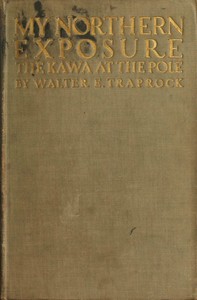
My Northern Exposure: The Kawa at the Pole — Inside the Classic
Edition facts
For My Northern Exposure: The Kawa at the Pole — Inside the Classic, the stored edition analysis reports 39,863 words, 2 hr 54 min estimated reading time, and 5 detected text sections.
The text analysis averages about 16.4 words per sentence, while the detected sections provide another way to judge how the source is divided.
Project Gutenberg metadata also associates the work with “Arctic regions -- Fiction,” connecting these edition facts with the source record’s subject description.
Calculated from edition completeness, EPUB availability, text structure and catalogue metadata. Not a user rating.
How this score is calculated
- Description quality20 pts
- Title & short description10 pts
- Source metadata20 pts
- Text length15 pts
- Chapters / structure15 pts
- EPUB file integrity20 pts
Total of 100 points, scaled to a 2.5-5.0 range. Editions with an empty description or a missing EPUB file are not scored.
Read the Text
"Pittsburgh!" would be the operator's triumphant comment. "Wait a minute!"
We waited many a minute and hour, patiently expectant, but nothing happened. The most trying thing was Whinney's explanation. He would fix us mournfully with his brown eyes, while at the same time trying to fix the machine and say solemnly:
"The length of the antennae is in direct relation to the wave length of the tuner. At the same time the vacuum tubes must be connected with or, at least, related by oscillation to the tuning circuit. When a ship is in motion the undue number of electric 'strays' disturbs the delicate filaments of the tickler and absolutely wrecks the radio activity."
"I had one of those Radio-Rex things," cried Swank. "My sweetie gave it to me for Xmas."
"I suppose you gave her a tickler," rumbled Triplett.
Ikik is solemn. Ikik is offended. Her tender heart is roused. Why? In the answer lies the story of one of the most charming incidents of the Kawa's entire polar-cruise. In another picture the reader will see Makuik descending with murderous intent, on the back of a large polar-bear. Shortly after the kill it was discovered that this bear had just become a mother. Her offspring--there was but one--was immediately adopted by Ikik. Mother-love, which flourishes even in the high latitudes, surrounded the little cub with every protection. First reared as a bottle-bear, the bearlet passed safely through the teething period and soon became the regular attendant of his foster-mother who fed him solicitously at every meal.
It was this devotion which brought about the disturbance recorded by the camera. Warburton Plock seems to have developed an insatiable fondness for toasted-blubber. Not content with his own share he resorted to the cowardly practice of prigging from Toktok, as this _ursus minimus_ was called. His method was characteristic of the man, combining cunning with greed. Having privately constructed a small cube of wood corresponding in size to the usual blubber-portion he would attract Toktok's attention and ostentatiously bury the decoy in the snow at some distance from the actual feeding ground. Then, while the little chap was busily digging for the supposed dainty Plock would swipe the real blubber which Makuik distributed with an impartial hand.
Ikik was no match in logic for the wily scientist.
"You are robbing my baby!" she wailed in the present instance.
"Yes," agreed Plock, "and your baby is under the impression that he is robbing me."
Needless to say Dr. Traprock settled this matter in his own direct fashion. As he said in conversation with the writer, "It is impossible to argue with such fellows. The only practical thing is to crown them."
The whole business vastly amused the old salt. He could see nothing but foolishness in Whinney's maneuvers, "trying to git God-a'mighty on the 'phone," as he put it.
But the attempts whiled away many an idle moment, and day by day we were passing landmarks which told me clearly that our goal was nearer. The water became steadily colder, a fact which we verified by the usual scientific method of dipping out pailfuls from time to time and taking their temperature with a bath thermometer.
At the northern end of Kane Basin where Greenland makes out toward Ellesmere and Grant Land we began to encounter ice. My readers can perhaps imagine the thrill which was mine when I first heard the soft scrape of frozen lips against the Kawa's silky skin!
Ice at last! Ice! the vaunted terror of the north! Leaning over the garboard streak I watched anxiously to see how our gallant carrier would take to the element for which she was designed. It was a magical performance and a warm glow of satisfaction suffused my heart as I noted how she slipped through the glazed surface. Far beyond in the northern sky gleamed the "ice blink," that luminous brightness which told of frozen fields and floes in the great beyond. We could feel the chill of their vast bulk as we sat on deck of an evening.
We were now at the 82nd parallel and were passing through what is known as mulch ice, which is of about the same consistency and saltiness as ordinary brine. Wigmore made a number of interesting experiments with a small freezer, using corn starch and condensed milk from his own equipment and was able to produce a fair quality of ice cream which had a slightly oily flavor doubtless due to the presence of seals. From then on the ice developed into what is called squidge-ice, thicker and more lumpy than mulch, but still navigable. This, however, soon became a solid sheet, from four to ten inches in thickness, the Kawa's progress became slower and with something like acute anxiety I requested Whinney to switch on the thermal water line.
The effect surprised even Whinney whose inventive imagination had proven itself capable of foreseeing almost anything which might happen and many which might not. We were instantly surrounded by a dense fog of our own making!
The ice edges of the squidge coming in contact with the candescent copper vaporized immediately and the atmosphere on board became that of a Turkish steam-room. As is often the case it was not so much the heat as the humidity.[6] Our clothing was wringing wet and we were perspiring at every pore. It was easy to see what the fatal result would be when we shut off the electric spark and exposed our wide-open pores to the icy breath of the north. Pneumonia and consumption, if not worse, were almost certain.
Ordering all hands below for a rub-down we came to a standstill and for two days did nothing more than maintain our position by quarter-speed revolutions of the Tutbury. At the end of that time Whinney emerged from the main hatch, where he had been incubating his ideas, with a look of suppressed elation which told me that he had found a solution of our difficulty. Without a word he set about stringing wires from the storage batteries to two points on the forward rail on a line with the capstan. In less time than it takes to tell it he had lashed two electric fans to the projecting sides of the guide runners and screwed the wires into the poles after which he walked aft and came to attention.
"You may fire when ready, sir," he said, hand-at-visor.
I gave the signal and once more the throb of the engines shook our jelly-like sides, once more we heard the hiss and crackle of the squidge as it gave way before our burning zone but--a new sound! We also heard the blended sonority of the two fans as they pushed a powerful current of air along our water line. Dense and low, the fog streamed past us like parted rivers of milk, to rise in soft clouds far to the southward.
A spontaneous cheer burst from my anxious band and we gave Whinney three times three with a right good will. At Triplett's suggestion--for he was overjoyed at being able to see where he was going--I ordered "half holiday" and issued five plugs of solid alcohol in honor of our resumed motion. It was a happy evening we spent in the little cabin, Triplett, Sausalito and I, while the others sat on deck in the pale sunlight, crooning the old song which has been sung by polar explorers since viking days, "Nordenskold! Nordenskold! Tilig am poel."[7]
Triplett's adjustable yard-arm which controlled our conviviality was occasionally shifted to keep the low circling sun directly over it and many a toast was eaten as the cheery plug passed round. My last conscious memory after my fifth quid, was the sound of Frissell's ukelele above my head and beside me the unabashed endearments of Triplett talking to his "apple."
[Footnote 5: Ekstrom illustrates the same point in his lectures by using a cake (usually chocolate) in place of a pie. The objection to this method is that the segmental walls have a tendency to crumble, confusing the illusion of polar travel. Otherwise his system follows mine.
[Footnote 6: In Taupol, the southernmost of the Maladive Islands, I lived for three months in a similar climate without injurious results but it must be borne in mind that I wore only a one-piece suit of Khitra (gobang leaves). T.]
[Footnote 7: "Northland! Northland! I for you am." Undoubtedly the fragment of an old Saga of Icelandic origin. A modern musical derivative was once popular in American folk song with the refrain, "Hip, Hooray, we're off for Baffin's Bay, etc." See W.J. Krehbiel's "Gems of Greenland," pp. 94-96.]
_We reach the polar cap. The strange incident of the missing Orders. Who stole the papers? The Arctic summer. A sportsman's Paradise. Notes from my journal. Whinney's sad experience._
"Men, it is the Ice."
These words rang with a portentous solemnity as I delivered them to the entire ship's company.
We had reached the solid floe. About us, white and interminable, stretched the polar pack, with here and there inky streaks, the open "leads" which often yawn between the very feet of unwary travellers. But for us, the way lay straight. Glancing at the compass and adjusting my gesture parallel to its needle, I pointed.
"Yonder lies the Pole!"
The seriousness of the moment imposed a silence broken only by the screams of distant flocks of pemmican and the yooping of seals--for we were in the land of prolific game. The second leg of our journey was accomplished. The great test still remained, the long tug over the rough floor to the Main Post itself.
"Men of the Traprock Expedition," I continued, "you have served me long and faithfully. The reward of our efforts lies close at hand. Yonder, I repeat, lies the Pole. Captain Triplett's last observation shows that we are at 86° 13´ 6-7/8´´, fifteen miles better than all previous records, Nansen's, Steffanson's and Peary's excepted. We are running ahead of schedule time. From now on our progress will be slower. But, though we will not be dragging light sledges over the ice, remember that we carry our base of supplies with us. 'Tis an arduous task, lads, but with fair weather and good luck we'll win through yet!"
THE NINE O'CLOCK BOTTLE
Here we have a typical scene in Camp Traprock during the late days of the Arctic-Indian-Summer. Bartholomew Dane, the Egyptologist and Sausalito are busily engaged nursing the expeditionary mascot, Toktok, a tiny bear-cub which was adopted by Ikik after the demise of its parent. The picture can give no idea of the painstaking care which was lavished upon the little pet. As in the case of many infants it was extremely difficult to find a food upon which he would gain his orthodox ounce a day. Various forms of nourishment were tried, the happy formula being finally found in a four-ounce bottle administered every four hours, the meal consisting of modified whale's-milk to which was added minute particles of "wheat-whiskers," a cereal-diluent to the perfection of which Dr. Traprock has devoted many years of study.
Ikik, to whom credit must be given for the capture of the cub, was hopelessly ignorant of how it should be cared for. Her idea was that common to most primitive mothers, namely, that the infant should be immediately put upon a meat or fat diet. The result of this treatment was loss of weight and incessant crying on the part of Toktok. Fortunately the ship's library contained a copy of Holt's "Care and Feeding of Infants," a book which Dr. Traprock says he never feels safe without.
Both Dane and Sausalito are wearing the summer costumes which are practically a necessity during the heated term. Dane's tropic helmet with its deeply overhanging cornice undoubtedly saved him from the dreaded snow-blindness which so fatally attacked his companion Whinney. The attractive dress worn by Sausalito is part of a wardrobe assembled by her as she passed through Canada on her way to join the expedition. The fur-edged chemisette and roll-down buskins are similar to the parade uniform of the O'Howese Toboggan Club.
The cheer which greeted this announcement surprised me by its feebleness. I had felt that I was doing rather well. Plainly a number of voices were silent. Puzzled and apprehensive I glanced toward my men. Warburton Plock, oily and deferential, stood slightly in advance of the others.
"Have you read your orders?" he asked.
"My orders?" I replied,--"my orders from whom?"
"Your sealed orders," he repeated, smiling craftily, "the ones Waxman handed you when we left."
I did not like his tone. I detested the familiar way in which he spoke of the aged president of the Explorers Union. His manner was that of veiled bravado. The air was highly charged as before a coming storm.
"My brief-case ... cabin ... Swank.... Fetch."
I was excited and spoke monosyllabically, but Swank, like a faithful dog, disappeared at the word "fetch" down the companion-way. In the interval of his absence a thousand black thoughts whirled through my brain. These mysterious orders, what were they? A plot ... something was afoot, some deadly blow aimed to dash the cup of accomplishment from my grasp as I raised it to my lips. To my credit I can say that, even in this agonizing moment, I absolved Dr. Waxman of any share in this dastardly work. I seemed to see his benevolent sheep-like face smiling a good-bye, while before me, glowered Plock, palpably gloating at my discomfiture. But orders were orders and duty was duty. Traprock must be true! With a hand that trembled in spite of my best efforts, I grasped the brief-case which Swank proffered and, turning it so that all might see, I opened it.
I stood like a conjurer surprised by his own trick.
A threatening growl rose from the group huddled about Plock who now came forward boldly, his face distorted with passion. The mask was off.
"This is buncomb, Traprock," he shouted. "You have done away with those orders! Where are they? You know perfectly well that your instructions are to...."
What he was about to divulge will never be known. Whipping up my left arm I caught his heel with my right foot and the back of his head struck the ice with a crack that roused the distant pemmican to renewed screaming.[8]
"Stow that dunnage," I said quietly, and the limp carcass was tossed aboard where it lolled grotesquely over the hatch-combing.
"To your places, you others...."
A slow, straining heave at the traces brought the Kawa up on her guide-runners and she moved gracefully across the ice.
Pondering mournfully on the strange turn of events, wondering who could have purloined the fateful packet, but taking care to show no exterior sign of my perplexity, I trudged on, occasionally breaking the silence with a single word of command.
Day succeeded day, days scarcely marked by any change, and yet there was no sign of the missing document. The most rigid search was fruitless and, gradually, the incident was forgotten.
So unbroken was the sunlight that it was only by exercising great care in keeping our watches wound that we were able to know definitely just what day it was. As time wore on, confusion arose. Miskin insisted that it was Wednesday, Swank held out for Thursday and so on. But it mattered little. They were all days of accomplishment and of glorious Arctic summer, growing steadily hotter as we climbed up the glacial coverlet. We were now beyond the latitude of my previous "farthest" (87° 21' 22") which I had reached with the Royal Geographic Expedition which met such a tragic fate on its return trip to England.[9]
The insect pests began to be very troublesome and I thanked the high Gods for the green veils and mosquito-bars which made life tolerable. A part of every man's equipment was an atomizer containing four fluid ounces of oil-of-citronella, and a fly-swatter attached to his wrist by a thong of reindeer sinew.[10]
I was amazed at the tropic temperature of these high latitudes. At noon the thermometer frequently stood around 90° Fahr. in the shade and it must be remembered that there _was_ no shade. Our thinnest garments were none too comfortable nor were we able to say, as is usual, that the nights were cool, for again it should be borne in mind that there were no nights. Hour after hour the brazen disc of the sun circled round the heavens, staring pitilessly at the moon which, strange phenomenon! shone palely above the opposite horizon as if the two great planets were balancing to partners in a stately astronomical dance.
At definite periods sleep was the order of the day, an enforced regulation. During our waking hours we struggled on, at times wading through mulch and squidge, at times sailing through seas of melted ice. Yet, though the sun's rays were hot, there still remained the solid pack below, too vast to be more than touched on the surface by this fleeting summer.
Though we were surrounded by animal life it was much too warm for hunting. In fact the very thought of such things as blubber and fur was nauseating. Our civilized diet and clothing were better suited to our stomachs both inside and out. But how quickly the warm polar weather passed none knew better than I and from my place in the bow I urged my men on until even Swank and Whinney cast reproachful glances at me over their streaming shoulders.
"You aren't taking the Kawa to the Pole, she's taking you," they complained.
A fact which was the cause of surprised comment by several members of the expedition was that we had thus far encountered no Eskimos on our journey. I confess that I myself was somewhat perplexed. In a country in which game abounded it seemed strange to find no hunting parties. I could account for this phenomenon by two courses of reasoning; either the natives had gone south to escape the intolerable weather which we were experiencing--for it will be remembered that these simple folk have practically no way of combating heat--or their hunters might possibly have fallen victims to the mistake so common to nimrods the world over, of leading their bands into localities in which there was no game whatever. Upon consideration the latter conclusion seemed the more probable for it follows a great general law of humanity. Each of my readers doubtless numbers among his acquaintance a sportsman who makes an annual pilgrimage into inaccessible regions in search of caribou, deer, salmon or big-horn and who invariably returns with a tale of disappointment. "It has been a very poor year for caribou." "There was too little water--or too much." These excuses are familiar to any one who holds converse with the disciples of rifle and rod.
Our case was different. We were a scientific group, not occupied with the capture of animal trophies and so we naturally saw a great deal of game.
It is difficult for me to set down the amazing amount of interesting live stock which flourished about us at every stage of our journey. In the lower latitudes these were the more familiar caribou, rabbits, wolves, and deer.
A sight I shall never forget was one which confronted us shortly after clearing the westernmost point of Wrangel Island. This was in the earlier stages of our journey while we still enjoyed a few hours of restful darkness. Through the murky night I heard a low muttering sound with an occasional note of complaint or discontent. The noise was not single and distinct but vast and widespread as if a large area of land had become vocal. "What do you suppose is wrong?" I asked Triplett with whom I was keeping watch. "There's allus somethin' wrong on Wrangel," said that worthy imperturbably. But I could see that he was interested for he kept his good-eye alternately on our compass and the dim bulk of land that loomed on our quarter.
Dawn came on apace and a marvellous picture lay before us. Far into the interior, on the snowy slopes, were millions of reindeer feeding on the Christmas trees which do so well in this locality. The noise I had heard was the swishing of great branches and the guttural grunts of these picturesque mammals as they devoured their provender. Others of my men had stolen on deck and stood silently watching. Frissell was greatly excited.
"Who said there wasn't any Santa Claus!" he cried, and at the sound of his voice the huge herd tossed its broad-leaved antlers and rushed madly toward the distant horizon while Frizzie urged them on with cries of "Now, Vixen, now, Dasher!" It was an odd but interesting scene.
The foreword by Irving T. Grosbeak sets the tone by questioning the motives of polar explorers, contrasting earlier commercial aims with modern claims of adding to human knowledge. The narrator, Dr. Walter E. Traprock, quickly establishes a deadpan absurdity: upon reaching the North Pole, his party finds they can all touch it with their backs, and stepping forward sends everyone south—even those walking opposite directions. This playful inversion of polar logic signals that the book will treat exploration conventions with irreverent humor.
The excerpts reveal a work that parodies the genre's earnestness through mock-scientific precision, such as the detailed recipe for Klinka skin sealing with otary oil and pemmican, and the observation that a blind crew member wrote a clearer account than those who saw everything. Readers should expect a satirical rather than realistic portrayal of Arctic life.
The Pole as a Punchline
The opening excerpts immediately subvert the heroic polar quest. Instead of a dramatic first at the Pole, the narrator describes a mundane verification: four men stand back-to-back, touch the Pole, then step forward—all go south. The joke is that the Pole is not a destination but a conceptual trick. Whinney's attempt to explain motion in one dimension, leaving the narrator to sneak away, exemplifies the book's preference for comic deflation over scientific awe. The foreword's dismissal of Peary's achievement as a mere transportation problem reinforces this irreverent stance.
Ethnographic Parody in the Klinka Sketches
The description of Klinka Eskimo hygiene is a sustained parody of anthropological writing. The narrator provides a numbered recipe for sealing the body with otary oil, Makuik-mixture, pemmican, and walrus-oil, finished with optional guppy-wax. The comparison to New Englanders sealing preserves with paraffin is a deliberately anachronistic and domestic touch. The spring sloughing ritual, where natives scrape off the oily layers with bone knives, is described with clinical detachment, and the photograph caption of little Kopek after his scouring emphasizes the supposed hygienic wisdom. This section mocks the tendency of explorers to present native customs as exotic yet rational.
Writing from Ignorance
A recurring motif is the value of inexperience. The narrator notes that his blind friend's account of the voyage became clearer and more interesting after he lost his sight and relied on secondhand information. This is framed as evidence for the theory that too much actual experience makes a man inarticulate. The narrator applies this logic to his own work, suggesting that the book's appeal lies in its departure from the devastating dullness of most polar accounts. Readers should be alert to how the narrator's unreliability and self-deprecating humor shape the narrative.
Structure and Voice
The excerpts show a layered structure: a foreword by a fictional academic, a first-person narrative that frequently digresses into mock-scientific explanations, and interpolated descriptions of photographs. The voice is consistently dry and understated, even when describing absurd situations. The narrator's tone remains that of a gentleman explorer reporting facts, which heightens the comedy. The book's brevity (under 40,000 words) and episodic nature suggest it can be read as a series of comic set pieces rather than a plotted novel. The dedication to five named Eskimos—and the single word 'Sausalito'—hints at the author's playful approach to authenticity.
Approach My Northern Exposure as a work of sustained parody that rewards attention to its deadpan delivery and mock-scholarly apparatus. The narrator's voice is the central comic device; his earnest explanations of absurdities create the humor. The book does not aim for realism or character development but for a series of inventive gags about polar exploration conventions. Readers familiar with early twentieth-century expedition literature will recognize the targets, but the comedy is accessible without that background.
Rain fell in long curtains against the window that afternoon, and I stayed curled with My Northern Exposure, laughing at its narrator who admits ignorance is the better compass. That confession lingered—how uncertainty can guide. Later, I found myself reaching for The Secret Sharer — Context and Discussion, remembering its captain, alone with his choices in the dark. Both felt like quiet company on a gray day.
Noah Nelson
4 weeks ago-
Diana Garcia - 1 month ago
I had high hopes for 'My Northern Exposure' but found it scattered and self-indulgent. The humor is forced, and the story lacks substance. The author spends too much time on irrelevant anecdotes and not enough on the actual journey. It feels like a draft that needed serious editing. -
Stephanie Ivan Moreno - 3 weeks ago
A quirky and original travelogue about an unusual expedition to the North Pole. The writing is clever and the observations are amusing. However, the narrative sometimes feels disjointed, and the book lacks a clear focus. Still, it's a fun and lighthearted read for those looking for something different. -
Stephanie Johnson - 2 weeks ago
An incredibly unique and entertaining read! 'My Northern Exposure: The Kawa At The Pole' blends humor with adventure in a way that keeps you hooked. The narrator's voice is witty and engaging, and the descriptions of the Arctic are vivid. A refreshing and enjoyable journey that I highly recommend.
What did you think of this book?
Answer a few questions and save a private reflection on this device.
Theodore White
1 month ago