
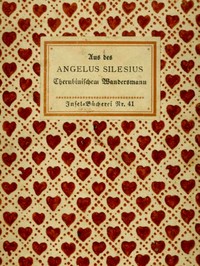
Aus des Angelus Silesius Cherubinischem Wandersmann by Angelus Silesius
So, what's this book actually about? It doesn't have a plot in the normal sense. There's no hero's journey or murder mystery. Instead, think of it as a spiritual field guide written in code. Angelus Silesius, a 17th-century doctor-turned-priest, gives us over 1,600 'epigrams'—super short, two-line poems. Each one is a condensed burst of mystical thought. He takes the core ideas of Christian mysticism and pushes them to their absolute limit.
The Story
There isn't a narrative story. The 'wandering' is a spiritual one. The book is the record of a soul wrestling with the nature of God, self, and eternity. One moment he's talking about the soul as a drop of water trying to merge with the ocean of God. The next, he's arguing that if you could let go of your own self completely, you'd find God right there. He makes statements that would have made the church authorities of his time very nervous, like claiming that even God depends on the human soul to be fully realized. It's a journey inward, a map of a mind trying to grasp the infinite.
Why You Should Read It
I'll be honest, some of it is tough. The language is old and the concepts are dense. But that's also why it's so rewarding. You don't read this book cover-to-cover in one sitting. You dip into it. You read three or four of these little poems with your morning coffee and let them rattle around in your head all day. The power is in their simplicity and their boldness. He cuts through centuries of complicated theology and says things like, 'God is a pure no-thing, beyond all here and now.' It's jarring and beautiful. It makes you stop and question your own assumptions about spirituality, whether you're religious or not. It feels less like reading and more like overhearing someone's most private and profound realizations.
Final Verdict
This is not a book for everyone. If you want a fast-paced novel, look elsewhere. But if you're the kind of person who enjoys philosophy, poetry, or spiritual writing that challenges you—think Rumi or the Tao Te Ching—you need to know about this. It's perfect for contemplative readers, poets looking for startling imagery, or anyone interested in the history of radical religious thought. Keep a translation with good notes beside you, take it slow, and prepare for some of the most audacious and luminous ideas ever put on paper.
This is a copyright-free edition. Feel free to use it for personal or commercial purposes.
James Davis
6 months agoThe peer-reviewed feel of this content gives me great confidence.
Patricia White
6 months agoI stumbled upon this title during my weekend research and the formatting on mobile devices is surprisingly crisp and clear. An excellent example of how quality digital books should be formatted.
Kimberly Wilson
1 year agoThis digital copy caught my eye due to its reputation, the data points used to support the main thesis are quite robust. Truly a masterpiece of digital educational material.
Sarah Hernandez
2 years agoUnlike many other resources I've purchased before, the transition between theoretical knowledge and practical application is seamless. I'll be recommending this to my students and colleagues alike.
Elizabeth Davis
8 months agoThe peer-reviewed feel of this content gives me great confidence.