
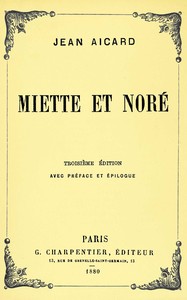
Miette et Noré by Jean Aicard
Jean Aicard's Miette et Noré is a quiet novel that packs a surprising emotional punch. First published in the late 1800s, it transports you to the sun-drenched hills and rustic villages of Provence, but don't let the picturesque setting fool you. This is a story about innocence facing a vague but potent threat.
The Story
The plot revolves around two peasant children: Miette, a gentle and perceptive girl, and Noré, a bright and spirited boy. They share a deep, platonic bond, exploring their world with the uncomplicated joy of youth. Their simple lives are disrupted when the Marquis de la Rouméguière, a wealthy and influential local landowner, becomes fixated on Noré. He showers the boy with unusual attention, gifts, and a disturbing desire to separate him from his humble roots and from Miette. The central question isn't about dramatic events, but about motivation. Why is this powerful man so obsessed with a poor village boy? The story unfolds through the children's confused perspective and the growing unease of the villagers, creating a slow-building tension that's incredibly effective.
Why You Should Read It
I loved this book for its atmosphere and subtlety. Aicard doesn't spell everything out. He makes you feel the warmth of the Provençal sun and the chill of the Marquis's gaze with equal skill. The relationship between Miette and Noré is beautifully drawn—it’s pure, loyal, and feels completely real. The real strength, though, is in the unease. The Marquis's intentions are ambiguous, hovering between paternalistic benevolance and something more sinister. This ambiguity forces you to lean in and read between the lines, making you an active participant in the story. It's a masterclass in showing how power imbalances can corrupt even seemingly kind gestures.
Final Verdict
This isn't a book for someone seeking a fast-paced plot. It's a character study and a mood piece. If you enjoy classic literature that explores social class, the loss of innocence, and the subtle dynamics of power, you'll find a lot to love here. It's perfect for readers who appreciate authors like George Sand or Thomas Hardy, where the setting is a character itself and the drama is psychological. Think of it as a historical novel with the tense, watchful feeling of a slow-burn thriller. Give yourself over to its pace, and you'll be rewarded with a story that lingers long after the last page.
This historical work is free of copyright protections. Share knowledge freely with the world.
James Miller
5 months agoHaving explored several resources on this, I find that the narrative arc keeps the reader engaged while delivering factual content. This has become my go-to guide for this specific topic.
Paul Rodriguez
1 year agoThe peer-reviewed feel of this content gives me great confidence.
Jennifer Gonzalez
1 month agoExtremely helpful for my current research project.
Oliver Scott
6 months agoSolid story.







Susan Harris
2 years agoBefore I started my latest project, I read this and the argument presented in the middle section is particularly compelling. Definitely a five-star contribution to the field.