
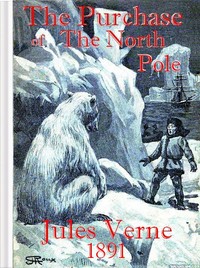
The Purchase of the North Pole A sequel to "From the earth to the moon" — A Reader’s Guide

(5 User reviews)   1366
Verne, Jules, 1828-1905 Project Gutenberg 2019 Not confirmed
Science fiction, French -- Translations into English Readers of public-domain and historical texts
Project Gutenberg digital edition en

Edition facts

Words 39,553
Reading time 172 min
Text sections 23

The catalog record for The Purchase of the North Pole A sequel to "From the earth to the moon" — A Reader’s Guide provides practical reading context through 39,553 words, 2 hr 52 min estimated reading time, and 23 detected text sections.

The text analysis averages about 17.6 words per sentence, while the detected sections provide another way to judge how the source is divided.

Project Gutenberg metadata also associates the work with “Science fiction, French -- Translations into English,” connecting these edition facts with the source record’s subject description.

Jules Verne's sequel to 'From the Earth to the Moon' follows the Gun Club's scheme to purchase the North Pole and alter Earth's axis. The excerpts reveal a debate on women in science, a French engineer's skepticism, and a shift in public opinion, grounding the fantastical premise in character-driven dialogue and calculation.
Share
Editorial Edition Score 4.8/5

Calculated from edition completeness, EPUB availability, text structure and catalogue metadata. Not a user rating.

How this score is calculated
  • Description quality20 pts
  • Title & short description10 pts
  • Source metadata20 pts
  • Text length15 pts
  • Chapters / structure15 pts
  • EPUB file integrity20 pts

Total of 100 points, scaled to a 2.5-5.0 range. Editions with an empty description or a missing EPUB file are not scored.

Edition quality

Read the Text

THE NORTH POLAR PRACTICAL ASSOCIATION 7

TO SYNDICATE OR NOT TO SYNDICATE 19

THE NORTH POLE IS KNOCKED DOWN TO THE HIGHEST BIDDER 27

THE POLAR COAL-FIELD 40

A TELEPHONIC CONVERSATION 47

BARBICANE MAKES A SPEECH 59

A CHANGE IN PUBLIC OPINION 80

THE CONTENTS OR THE NOTE-BOOK 87

A TRULY EPIC REPLY 98

THE GEOGRAPHICAL VALUE OF _x_ 106

INTERESTING FOR THE INHABITANTS OF THE TERRESTRIAL SPHEROID 107

THE CHORUS OF TERROR 114

THE WORKS AT KILIMANJARO 117

THE WAMASAI WAIT FOR THE WORD TO FIRE 126

J. T. MASTON REGRETS HE WAS NOT LYNCHED 129

THE END OF THIS REMARKABLE STORY 136

THE PURCHASE OF THE NORTH POLE.

CHAPTER I. THE NORTH POLAR PRACTICAL ASSOCIATION.

“And so, Mr. Maston, you consider that a woman can do nothing for the advance of the mathematical or experimental sciences?”

“To my extreme regret, Mrs. Scorbitt,” said J. T. Maston, “I am obliged to say so. That there have been many remarkable female mathematicians, especially in Russia, I willingly admit; but with her cerebral conformation it is not in a woman to become an Archimedes or a Newton.”

“Then, Mr. Maston, allow me to protest in the name of my sex—”

“Sex all the more charming, Mrs. Scorbitt, from its never having taken to transcendental studies!”

“According to you, Mr. Maston, if a woman had seen an apple fall she would never have been able to discover the laws of universal gravitation as did the illustrious Englishman at the close of the seventeenth century!”

“In seeing an apple fall, Mrs. Scorbitt, a woman would have only one idea—to eat it, after the example of our mother Eve.”

“You deny us all aptitude for the higher speculations—”

“All aptitude? No, Mrs. Scorbitt. But I would ask you to remember that since there have been people on this earth, and women consequently, there has never been discovered a feminine brain to which we owe a discovery in the domain of science analogous to the discoveries of Aristotle, Euclid, Kepler, or Laplace.”

“Is that a reason? Is it inevitable that the future should be as the past?”

“Hum! That which has not happened for thousands of years is not likely to happen.”

“Then we must resign ourselves to our fate, Mr. Maston. And as we are indeed good—”

“And how good!” interrupted J. T. Maston, with all the amiable gallantry of which a philosopher crammed with _x_ was capable.

Mrs. Scorbitt was quite ready to be convinced.

“Well, Mr. Maston,” she said, “each to his lot in this world. Remain the extraordinary mathematician that you are. Give yourself entirely to the problems of that immense enterprise to which you and your friends have devoted their lives! I will remain the good woman I ought to be, and assist you with the means.”

“For which you will have our eternal gratitude,” said J. T. Maston.

Mrs. Scorbitt blushed deliciously, for she felt, if not for philosophers in general, at least for J. T. Maston, a truly strange sympathy. Is not a woman’s heart unfathomable?

An immense enterprise it was which this wealthy American widow had resolved to support with large sums of money. The object of its promoters was as follows:—

The Arctic territories, properly so called, according to the highest geographical authorities, are bounded by the seventy-eighth parallel, and extend over fourteen hundred thousand square miles, while the seas extend over seven hundred thousand.

Within this parallel have intrepid modern discoverers advanced nearly as far as the eighty-fourth degree of latitude, revealing many a coast hidden beyond the lofty chain of icebergs, giving names to capes, promontories, gulfs, and bays of these vast Arctic highlands. But beyond this eighty-fourth parallel is a mystery, the unrealizable desideratum of geographers. No one yet knows if land or sea lies hid in that space of six degrees, that impassable barrier of Polar ice.

In this year, 189—, the United States Government had unexpectedly proposed to put up to auction the circumpolar regions then remaining undiscovered, having been urged to this extraordinary step by an American society which had been formed to obtain a concession of the apparently useless tract.

Some years before the Berlin Conference had formulated a special code for the use of Great Powers wishing to appropriate the property of another under pretext of colonization or opening up commercial routes. But this code was not applicable, under the circumstances, as the Polar domain was not inhabited. Nevertheless, as that which belongs to nobody belongs to all, the new society did not propose to “take” but to “acquire.”

In the United States there is no project so audacious for which people cannot be found to guarantee the cost and find the working expenses. This was well seen when a few years before the Gun Club of Baltimore had entered on the task of despatching a projectile to the Moon, in the hope of obtaining direct communication with our satellite. Was it not these enterprising Yankees who had furnished the larger part of the sums required by this interesting attempt? And if it had succeeded, would it not be owing to two of the members of the said club who had dared to face the risk of an entirely novel experiment?

If a Lesseps were one day to propose to cut a gigantic canal through Europe and Asia, from the shores of the Atlantic to the China Sea; if a well-sinker of genius were to offer to pierce the earth in the hopes of finding and utilizing the beds of silicates supposed to be there in a fluid state; if an enterprising electrician proposed to combine the currents disseminated over the surface of the globe so as to form an inexhaustible source of heat and light; if a daring engineer were to have the idea of storing in vast receptacles the excess of summer temperature, in order to transfer it to the frozen regions in the winter; if a hydraulic specialist were to propose to utilize the force of the tide for the production of heat or power at will; if companies were to be formed to carry out a hundred projects of this kind—it is the Americans who would be found at the head of the subscribers, and rivers of dollars would flow into the pockets of the projectors, as the great rivers of North America flow into—and are lost in—the ocean.

It was only natural that public opinion should be much exercised at the announcement that the Arctic regions were to be sold to the highest bidder, particularly as no public subscription had been opened with a view to the purchase, for “all the capital had been subscribed in advance,” and, “it was left for Time to show how it was proposed to utilize the territory when it had become the property of the purchaser!”

Utilize the Arctic regions! In truth such an idea could only have originated in the brain of a madman!

But nevertheless nothing could be more serious than the scheme.

In fact, a communication had been sent to many of the journals of both continents, concluding with a demand for immediate inquiry on the part of those interested. It was the _New York Herald_ that first published this curious farrago, and the innumerable patrons of Gordon Bennett read, on the morning of the 7th of November, the following advertisement, which rapidly spread through the scientific and industrial world, and became appreciated in very different ways:—

“NOTICE TO THE INHABITANTS OF THE TERRESTRIAL GLOBE.

“The regions of the North Pole situated within the eighty-fourth degree of north latitude have not yet been utilized, for the very good reason that they have not yet been discovered.

“The furthest points attained by the navigators of different nations are the following:— 82° 45′, said to have been reached by the Englishman, Parry, in July, 1847, in long. 28° E. north of Spitzbergen; 83° 20′ 28″, said to have been reached by Markham in the English expedition of Sir John Nares, in May, 1876, in long. 50° W. north of Grinnell Land; 83° 35′, said to have been reached by Lockwood and Brainard in the American expedition of Lieutenant Greely, in May, 1882, in long. 42° W. in the north of Nares’ Land.

“It can thus be considered that the region extending from the eighty-fourth parallel to the Pole is still undivided among the different States of the globe. It is, therefore, excellently adapted for annexation as a private estate after formal purchase in public auction.

“The property belongs to nobody by right of occupation, and the Government of the United States of America, having been applied to in the matter, have undertaken to name an official auctioneer for the purposes of its disposal.

“A company has been formed at Baltimore, under the title of the North Polar Practical Association, which proposes to acquire the region by purchase, and thus obtain an indefeasible title to all the continents, islands, islets, rocks, seas, lakes, rivers, and watercourses whatsoever of which this Arctic territory is composed, although these may be now covered with ice, which ice may in summertime disappear.

“It is understood that this right will be perpetual and indefeasible, even in the event of modification—in any way whatsoever—of the geographical or meteorological conditions of the globe.

“The project having herewith been brought to the knowledge of the people of the two worlds, representatives of all nations will be admitted to take part in the bidding, and the property will be adjudged to the highest bidder.

“The sale will take place on the 3rd of December of the present year in the Auction Mart at Baltimore, Maryland, United States of America.

“For further particulars apply to William S. Forster, provisional agent of the North Polar Practical Association 93, High Street, Baltimore.”

It may be that this communication will be considered as a madman’s freak; but at any rate it must be admitted that in its clearness and frankness it left nothing to be desired. The serious part of it was that the Federal Government had undertaken to treat a sale by auction as a valid concession of these undiscovered territories.

Opinions on the matter were many. Some readers saw in it only one of those prodigious outbursts of American humbug, which would exceed the limits of puffism if the depths of human credulity were not unfathomable. Others thought the proposition should be seriously entertained. And these laid stress on the fact that the new company had not appealed to the public for funds. It was with their own money that they sought to acquire the northern regions. They did not seek to drain the dollars and banknotes of the simple into their coffers. No! All they asked was to pay with their own money for their circumpolar property! This was indeed extraordinary!

To those people who were fond of figures it seemed that all the said company had to do was to buy the right of the first occupant, but that was difficult, as access to the Pole appeared to be forbidden to man, and the new company would necessarily act with prudence, for too many legal precautions could hardly be taken.

It was noticed that the document contained a clause providing for future contingencies. This clause gave rise to much contradictory interpretation, for its precise meaning escaped the most subtle minds. It stipulated that the right would be perpetual, even in the event of modification in any way whatsoever of the geographical or meteorological conditions of the globe. What was the meaning of this clause? What contingency did it provide for? How could the earth ever undergo a modification affecting its geography or meteorology, especially in the territories in question?

“Evidently,” said the knowing ones, “there is something in this!”

Explanations there were many to exercise the ingenuity of some and the curiosity of others.

The _Philadelphia Ledger_ made the following suggestion:—

“The future acquirers of the Arctic regions have doubtless ascertained by calculation that the nucleus of a comet will shortly strike the earth in such a manner that the shock will produce the geographical and meteorological changes for which the clause provides.”

This sounded scientific, but it threw no light on the matter. The idea of a shock from such a comet did not commend itself to the intelligent. It seemed inadmissible that the concessionaries should have prepared for so hypothetical an eventuality.

“Perhaps,” said the _New Orleans Delta_, “the new company imagine that the precession of the equinoxes will produce the modification favourable to the utilization of their new property.”

“And why not,” asked the _Hamburger Correspondent_, “if the movement modifies the parallelism of the axis of our spheroid?”

“In fact,” said the Paris _Revue Scientifique_, “did not Adhemar say, in his book on the revolutions of the sea, that the precession of the equinoxes, combined with the secular movement of the major axis of the terrestrial orbit, would be of a nature to bring about, after a long period, a modification in the mean temperature of the different parts of the Earth, and in the quantity of ice accumulated at the Poles?”

“That is not certain,” said the _Edinburgh Guardian_, “and even if it were so, would it not require a lapse of twelve thousand years for Vega to become our pole-star, in accordance with the said phenomenon, and for the Arctic regions to undergo a change in climate?”

“Well,” said the _Copenhagen Dagblad_, “in twelve thousand years it will be time enough to subscribe the money. Meanwhile we do not intend to risk a krone.”

But although the _Revue Scientifique_ might be right with regard to Adhemar, it was probable that the North Polar Practical Association had never reckoned on a modification due to the precession of the equinoxes. And no one managed to discover the meaning of the clause, or the cosmical change for which it provided.

To ascertain what it meant application might perhaps be made to the directorate of the new company? Why not apply to its chairman? But the chairman was unknown! Unmentioned, too, were the secretary and directors. There was nothing to show from whom the advertisement emanated. It had been brought to the office of the _New York Herald_ by a certain William S. Forster, of Baltimore, a worthy agent for codfish, acting for Ardrinell and Co., of Newfoundland, and evidently a man of straw. He was as mute on the subject as the fish consigned to his care, and the cleverest of reporters and interviewers could get nothing out of him.

But if the promoters of this industrial enterprise persisted in keeping their identity a mystery, their intentions were indicated clearly enough.

They intended to acquire the freehold of that portion of the Arctic regions bounded by the eighty-fourth parallel of latitude, with the North Pole as the central point.

Nothing was more certain than that among modern discoverers only Parry, Markham, Lockwood and Brainard had penetrated beyond this parallel. Other navigators of the Arctic seas had all halted below it. Payer, in 1874, had stopped at 82° 15′, to the north of Franz Joseph Land and Nova Zembla; De Long, in the _Jeannette_ expedition in 1879, had stopped at 78° 45′, in the neighbourhood of the islands which bear his name. Others, by way of New Siberia and Greenland, in the latitude of Cape Bismarck, had not advanced beyond the 76th, 77th, and 79th parallels; so that by leaving a space of twenty-five minutes between Lockwood and Brainard’s 83° 35′ and the 84° mentioned in the prospectus, the North Polar Practical Association would not encroach on prior discoveries. Its project affected an absolutely virgin soil, untrodden by human foot.

The area of the portion of the globe within this eighty-fourth parallel is tolerably large.

From 84° to 90° there are six degrees, which, at sixty miles each, give a radius of 360 miles and a diameter of 720 miles. The circumference is thus 2216 miles, and the area, in round numbers, 407,000 square miles. This is nearly a tenth of the whole of Europe—a good-sized estate!

The advertisement, it will have been noticed, assumed the principle that regions not known geographically and belonging to nobody in particular belonged to the world at large. That the majority of the Powers would admit this contention was supposable, but it was possible that States bordering on these Arctic regions, or considering the regions as the prolongation of their dominions towards the north, might claim a right of possession. And their pretensions would be all the more justified by the discoveries that had been made having been chiefly due to these regions; and of course the Federal Government, as nominators of the auctioneer, would give these Powers an opportunity of claiming compensation, and satisfy the claim with the money realized by the sale. At the same time, as the partisans of the North Polar Practical Association continually insisted, the property was uninhabited, and as no one occupied it, no one could oppose its being put up to auction.

The bordering States with rights not to be disregarded were six in number—Great Britain, the United States, Denmark, Sweden and Norway, Holland, and Russia. But there were other countries that might put in a claim on the ground of discoveries made by their navigators.

France might, as usual, have intervened on account of a few of her children having taken part in occasional expeditions. There was the gallant Bellot, who died in 1853 near Beechey Island, during the voyage of the _Phœnix_, sent in search of Sir John Franklin. There was Dr. Octave Pavy, who died in 1884 at Cape Sabine, during the stay of the Greely expedition at Fort Conger. And there was the expedition in 1838–39, which took to the Spitzbergen Seas, Charles Martins and Marmier and Bravais, and their bold companions. But France did not propose to meddle in the enterprise, which was more industrial than scientific; and, at the outset, she abandoned any chance she might have of a slice of the Polar cake.

It was the same with Germany. She could point to the Spitzbergen expedition of Frederick Martens, and to the expeditions, in 1869–70, of the _Germania_ and _Hansa_, under Koldewey and Hegeman, which reached Cape Bismarck on the Greenland coast. But notwithstanding these brilliant discoveries she decided to make no increase to the Germanic empire by means of a slice from the Pole.

So it was with Austria-Hungary, which, however, had her claims on Franz Joseph Land to the northward of Siberia.

As Italy had no right of intervention she did not intervene—which is not quite so obvious as it may appear.

The same happened with regard to the Samoyeds of Siberia, the Eskimos who are scattered along the northern regions of America, the natives of Greenland, of Labrador, of the Baffin Parry Archipelago, of the Aleutian Islands between Asia and America, and of Russian Alaska, which became American in 1867. But these people—the undisputed aborigines of the northern regions—had no voice in the matter. How could such poor folks manage to make a bid at the auction promoted by the North Polar Practical Association? And if they outbid the rest, how could they pay? In shellfish, or walrus teeth, or seal oil? But surely they had some claim on this territory? Strange to say, they were not even consulted in the matter!

Such is the way of the world!

CHAPTER II. TO SYNDICATE OR NOT TO SYNDICATE.

If the new company “acquired” the Arctic regions, these regions would, owing to the company’s nationality, become for all practical purposes a part of the United States. What would the first inhabitant say? Would the other Powers permit it?

The Swedes and Norwegians were the owners of the North Cape, situated within the seventieth parallel, and made no secret that they considered they had rights extending beyond Spitzbergen up to the Pole itself. Had not Kheilhau, the Norwegian, and Nordenskiold, the celebrated Swede, contributed much to geographical progress in those regions? Undoubtedly.

Denmark was already master of Iceland and the Faroe Isles, besides the colonies in the Arctic regions at Disco, in Davis’s Straits; at Holsteinborg, Proven, Godhavn, and Upernavik, in Baffin Sea; and on the western coast of Greenland. Besides, had not Behring, a Dane in the Russian service, passed through in 1728 the straits now bearing his name? And had he not thirteen years afterwards, died on the island also named after him? And before him, in 1619, had not Jon Munk explored the eastern coast of Greenland, and discovered many points up to then totally unknown? Was not Denmark to have a voice in the matter?

There was Holland, too. Had not Barents and Heemskerk visited Spitzbergen and Nova Zembla at the close of the sixteenth century? Was it not one of her children, Jan Mayen, whose audacious voyage in 1611 gave her possession of the island named after him situated within the seventy-first parallel?

The opening chapter of The Purchase of the North Pole immediately establishes a debate over women's aptitude for higher mathematics, as J. T. Maston tells Mrs. Scorbitt that no woman has produced a scientific discovery comparable to Aristotle or Newton. This exchange, set before any mention of the polar scheme, signals Verne's interest in grounding speculative engineering in contemporary intellectual disputes. The novel's subtitle, 'A Sequel to From the Earth to the Moon,' prepares readers for a return to the Gun Club's ambitious projects, but the excerpts show that the narrative voice lingers on character traits—such as Alcide Pierdeux's methodical mind and his habit of coining terms like 'canisdentum'—rather than rushing into technical exposition.

A Debate on Scientific Aptitude

The first chapter presents a pointed exchange between J. T. Maston and Mrs. Scorbitt. Maston insists that women cannot become an Archimedes or a Newton, while Mrs. Scorbitt protests that a woman seeing an apple fall would not have discovered gravity. Maston retorts that she would only think of eating it. This dialogue, though brief, reveals Verne's willingness to stage contemporary arguments about gender and science within his fiction. The exchange is not merely decorative; it establishes Mrs. Scorbitt as a character who will challenge the male-dominated Gun Club. The catalog subject 'Science fiction, French' does not capture this social dimension. Readers should note that the novel's opening prioritizes character conflict over plot mechanics, a choice that shapes the tone of the sequel.

The French Engineer's Skeptical Eye

Alcide Pierdeux, introduced as a French engineer on holiday, provides an outsider's perspective on the Gun Club's plan. The excerpts describe his methodical mind, his loyalty to 'Code X' among Polytechnicians, and his habit of speaking in picturesque phrases like 'that is the canisdentum' to mean 'the rub.' He is skeptical of Barbicane's scheme to alter Earth's axis, wondering whether the 'knock' will be a side hit or a square hit that could jolt Earth out of its orbit. His calculations are frustrated because Barbicane's plan remains a mystery. This character serves as a foil to the American enthusiasm of the Gun Club, and his presence underscores the international dimension of the project. The catalog subject 'Science fiction, French' is accurate, but the excerpts show that Verne uses a French protagonist to inject a note of rational doubt into the narrative.

Shifting Public Opinion and Unspoken Risks

Chapter X, titled 'A Change in Public Opinion,' describes how a month after the Gun Club's meeting, the advantages of altering Earth's axis are being forgotten and the disadvantages enlarged upon. The narrator notes that a catastrophe seems unavoidable, though no one can specify what it will be. The only potential beneficiaries are Eskimos, Laps, and Samoyeds. This shift in public sentiment is presented without detailed technical explanation; instead, Verne focuses on the psychological and social reaction to the plan. The excerpts do not reveal whether the project proceeds or fails, leaving the outcome uncertain. Readers should observe how Verne balances the speculative premise with a realistic portrayal of public debate, a technique that distinguishes this sequel from pure adventure fiction.

The excerpts from The Purchase of the North Pole suggest a novel that intertwines character study with speculative engineering. Readers familiar with From the Earth to the Moon will recognize the Gun Club's audacity, but the sequel introduces new voices—Mrs. Scorbitt's challenge to scientific authority, Alcide Pierdeux's measured skepticism—that complicate the narrative. Pay attention to how Verne uses dialogue and internal reflection to advance the plot, and note that the full text may resolve the mystery of Barbicane's plan only after sustained character development.

Reading about the Gun Club’s absurd, calculable scheme, I remembered my own father’s slide rule, its quiet clicks our bedtime lullaby. That same patient, scientific faith fills The Purchase of the North Pole, yet another book, The man with the broken ear — Text and Context, once stirred it too. Both feel like old, brass instruments—precise, slightly foolish, and full of a stubborn, touching sincerity.

William Jackson
2 weeks ago

Gabriel Rodriguez
4 weeks ago

Gabriel Sanchez
1 month ago

Sophia Hill
1 month ago

Lucas Campbell
1 week ago

5
5 out of 5 (5 User reviews )

Add a Review

Your Rating *
  • ...
    Charlene Jenkins - 3 weeks ago
    A typical Verne adventure with an outlandish plot that's fun if you can suspend disbelief. The scientific discussions are interesting but may be dry for some. The pacing lags in the middle, but the finale is satisfying. A good addition to the series for Verne enthusiasts.

  • ...
    Jennifer Harris - 2 weeks ago
    This sequel lacks the charm and innovation of the original. The idea of purchasing the North Pole is silly, and the execution is tedious. The characters have become one-dimensional, and the science is outdated even for Verne's time. The plot drags with endless calculations and lectures. It feels like Verne was just cashing in on his previous success. Not worth the trouble.

  • ...
    Albert Soto - 2 weeks ago
    A delightful sequel that continues the fantastical journey of the moon adventurers. Jules Verne's imagination is as boundless as ever, and the new direction of purchasing the North Pole is both absurd and brilliant. The science, though of its time, is presented with such conviction that you're drawn in. The characters are as charming as before. A wonderful romp that mixes humor, science, and adventure—a true classic that entertains and educates.


Reader reflection

What did you think of this book?

Answer a few questions and save a private reflection on this device.

Your progress 0 / 10
1

Which reading stage best describes you?

2

What was your overall reaction to the book?

3

How likely are you to recommend this book?

4

What was the reading difficulty like?

Related eBooks