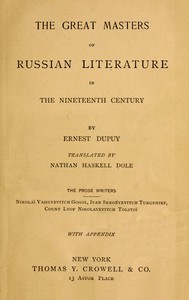
The great masters of Russian literature in the nineteenth century — Inside the Classic

(4 User reviews)   702
Dupuy, Ernest, 1849-1918, Dole, Nathan Haskell, 1852-1935 [Translator] Project Gutenberg 2023 Not confirmed
Tolstoy, Leo, graf, 1828-1910; Russian literature -- 19th century -- History and criticism; Turgenev, Ivan Sergeevich, 1818-1883; Gogol, Nikolai Vasilevich, 1809-1852 Readers of public-domain and historical texts
Project Gutenberg digital edition en

Edition facts

Words 87,486
Reading time 381 min
Text sections 15

Before opening The great masters of Russian literature in the nineteenth century — Inside the Classic, the edition data offers a quick orientation: 87,486 words, 6 hr 21 min estimated reading time, and 15 detected text sections.

The text analysis averages about 20.7 words per sentence, while the detected sections provide another way to judge how the source is divided.

Project Gutenberg metadata also associates the work with “Tolstoy, Leo, graf, 1828-1910,” connecting these edition facts with the source record’s subject description.

Ernest Dupuy's 1886 critical study examines Gogol, Turgenev, and Tolstoy through their diction, dialogue, and descriptive choices, tracing how each author forged a distinctly Russian literary voice from folk legends, social observation, and moral urgency.
Share
Editorial Edition Score 4.8/5

Calculated from edition completeness, EPUB availability, text structure and catalogue metadata. Not a user rating.

How this score is calculated
  • Description quality20 pts
  • Title & short description10 pts
  • Source metadata20 pts
  • Text length15 pts
  • Chapters / structure15 pts
  • EPUB file integrity20 pts

Total of 100 points, scaled to a 2.5-5.0 range. Editions with an empty description or a missing EPUB file are not scored.

Edition quality

Read the Text

able to hold his own in rebellion against the direction of his instructors, and neither the dead nor the living languages brought him any gain. He thus failed of becoming a commonplace man of letters, and consequently had less trouble in the end with discovering his original genius.

In his father’s house, on the other hand, he received a priceless education, such as Pushkin, in spite of all his efforts, vainly attempted to obtain. He was imbued with the poetry of the people. His childhood was entertained by the marvellous legends of the Malo-Russians. Gogol’s grandfather was one of those Zaparog Cossacks whose heroic exploits the author of “Taras Bulba” was destined to celebrate. He excelled in the art of story-telling, and his narrations had a tinge of mystery about them that brought the cold chills. “When he was speaking I would not move from my place all day long, but would listen, ... and the things were so strange that I always shivered, and my hair stood on end. Sometimes I was so frightened by them, that at night every thing seemed like God knows what monsters.” This fund of mainly fantastic and diabolical legends afterwards furnished the grandson of the Ukraïne village story-teller, with the material for his first original work.[2]

Gogol’s first attempts were not original: he began too early. Scarcely out of the gymnasium, he began to write in rhyme; in the morning trying all the styles in vogue, at evening making parodies upon them. He established a manuscript journal “The Star” (_Zvyezd_). The student intoxicated by reading Pushkin still remained in the trammels of uninspired verse, in the formulas of romanticism. Some characteristics already began to reveal the precocious observer, the brilliant satirist. Thus his prose articles, clandestinely introduced, had a tremendous success never equalled in his ripest years, even by his comedy of “The _Revizor_.”

After his studies were ended, Gogol was obliged to conquer the favor of a public less complacent than the rhetoricians and philosophers of Niézhin. He obtained (1830) an exceedingly modest office in the Ministry of Appanages (_Udyélui_). But in the bureau, where, like Popritshchin in the “Recollections of a Lunatic” his service was limited to sharpening dozens of pens for the director, he worked out a comedy on the pattern of Scribe’s, and spun a cottony idyl in the German style. The comedy was hissed by the public, and the idyl was so unkindly received by the critics that Gogol had this attempt withdrawn from the market.[3]

Gogol almost simultaneously shook off the double yoke of bureaucratic slavery and literary imitation. Instead of following, like so many others, in the track of French, English, or German writers, he determined to be himself. He went back over the course of his early years to find in this way in all their freshness the impressions of his childhood; he returned to his first, his real masters, and began once more to get material around the Malo-Russian hearth. He appealed to his mother for recollections; he besought the aid of his friends; he put them like so many bloodhounds on the track of half-forgotten legends, half-vanished traditions; he collected documents of every sort and kind: and when he was sufficiently permeated with savagery to think and speak, if need were, like a Cossack of the last century, he created a work at once modern and archaic, learned and enthusiastic, mystic and refined,--Russian, in a word,--and published it under the title “Evenings at the Farm” (_Vetchera na Khutoryé bliz Dikanki_).

This series of fantastic tales, published in the reviews under the pseudonyme of Rudui Panko (Sandy the little nobleman), produced a singular effect. The Russian reader was surprised and charmed in the same way as a French traveller, who, after having visited all the countries and admired all the floras of the world, should discover the banks of the Seine, and declare that he was willing to exchange the splendors of the savannas for a tuft of turf and a bunch of violets. No one was more struck with the value of these tales than Pushkin. He recommended their author to Pletnef, minister of public instruction; and Gogol was appointed professor. The servitude was still more onerous than that of the bureaucracy. The young writer had too much originality to bend under it very long: a second time he escaped, and took his departure for the Ukraïna.

The Zaparog Cossack’s grandson used to say that there was material for an Iliad in the exploits of his ancestors. He buried himself in the study of the annals of Little Russia; he collected the traditions; more than all, he picked up the national songs of the Ukraïna,--those kinds of heroic cantilenas composed by the players of the bandura. A modern _diaskenastes_, he constructed a body out of all these poetic remains, joined them together by means of a romantic plot, and renewed the astonishment caused by the appearance of “Evenings at the Farm,” by publishing “Taras Bulba.” The minister was convinced that a man who could thus revivify history could not fail to be skilled in teaching it: he therefore offered Gogol the chair of mediæval history in the University of Petersburg. The romancer gave only one lecture, his opening lecture. This day he dazzled his audience. The remainder of his course was for both students and professor only a long-continued bore, which ended finally in his losing the place.

Gogol dreamed of a different success. In 1835 he published his comedy, “The _Revizor_” (The Inspector General). It was applauded, and, what was of more value, it was desperately attacked. The author gained as many admirers and enemies as “Tartuffe” cost Molière. At Petersburg, as at Paris, the masterpiece was produced on the stage, and kept before the public, only by a fortunate caprice on the part of the sovereign.

Gogol’s health, which had long been failing, caused him about this period to leave Russia. He lived many years in Italy. There he completed his great romance, “Dead Souls” (_Mertvuia Dushi_). The work appeared in complete form in 1841.[4] The author had reached a state of nervous irritation and hypochondria, which was more and more manifested in his correspondence, published in part towards 1846. The last years of Gogol’s life were only a long torture. A sort of mystic madness took possession of his brain, exhausted or over-excited by production: death put an end to his nervous disease (1852).

Dreaminess and banter are the two natural tendencies, the two favorite pleasures, of the Russian mind. They are also the two elements of Gogol’s talent. At the beginning of his career as a writer, and during the sprightly years of his youth, it is dreaminess which prevails: the narrator penetrates with enthusiasm into the untrodden paths of the Malo-Russian legends. On the track of witches, of Rusalkas, he finds the unpublished poetry of the forests, the ponds, the wide stretches, and the sky of the steppes. These lovely days pass. With age, this restless spirit grows gloomy and melancholy. The observer’s eyes turn from the pacifying spectacle of nature, and attempt only to notice the vexing absurdities of humanity.

The satirical spirit in Gogol is first expressed in verse. He is poetical only in prose; but his prose is equal to the most beautiful verse. In truth, poetry is not rhyme, or metre, or even rhythm: it is the power of touching, of recording its impressions in vivid and genuine images. To feel emotion suitable for poetic expression, there is no need of picturing lofty heroes, or of spreading marvellous landscapes before the eyes. Properly speaking, a Malo-Russian peasant is like a hero in Corneille; and the imagination of an author, and therefore of his reader, can just as well be stirred by the view of a bit of the flat and naked steppe, as by the sight of the Bay of Naples or a sunset on the ruins of the Coliseum.

Gogol understood this, and, what is far better, made it understood. Instead of preparing his imitation of Werther and his copy of Childe Harold in the fashion of so many others, he had the courage to go to Nature for his models. And in this Russian nature, the wild grace and strange flavor of which he was, so to speak, the first to feel, that which attracts him more than all else is its unostentatious aspect. His field of observation is the village. His heroes are unimportant people, half-barbarous peasants, true Cossack lads, hard drinkers, with circumscribed intellectual training, with superstitious imaginations; in a word, very simple souls, whose artless passions are shown without any veil, but whose very ingenuousness is a deliriously restful contrast to our romantic or theatrical characters, so artificial in their labored mechanism, so insipid and perfunctory in the refinements of their conventionality.

Gogol places his characters in their natural surroundings. It is the hamlet bordering on the steppe, monotonous and infinite, deserted and mysterious. All this country appeals to the writer’s imagination, as well as to that of those Malo-Russians, whose history, past and present, he will describe for us in turn. Each shrub inshrines a memory; each winding valley veils a legend. In yonder stretch of water, beset with rushes and starred with nenuphars, the sceptic traveller in his indifference sees only a sort of marsh. The peasant who is here a poet, and the poet who remembers that he was once a peasant, know well who the Rusalka is who has been hiding there these many years. From its surface, on nights when the moon lights up the silvery mist, the queen of the drowned comes forth with her train of virgins, to find and drag into the depths of the water her stepmother, the witch whose evil deeds drove her to suicide.

But to move those whom she has brought forth, this land of the Ukraïna has no need of being wrapped in mystery. Gogol has only to pronounce the name of the Dniépr to arouse a sort of passionate woe, whose expression, unhappily almost untranslatable, equals in beauty the accents of the noblest poetry.

[5]“Marvellous is the Dniépr in peaceful weather, when he rolls his wide waters in a free and reposeful course by forests and mountains. Not the slightest jar, not the slightest tumult. Thou beholdest, and thou canst not tell if his majestic breadth is moving or is stationary. It is almost like a sheet of molten glass. It might be compared to a road of blue ice, without measure in its breadth, without limit to its length, describing its wondrous curves in the emerald distance. How delightful for the burning sun to turn his gaze to earth, and to plunge his rays into the refreshing coolness of the glassy waves, and for the trees along the bank to see their reflections in this crystal mirror! Oh the green-crowned trees! They stand in groups with the flowers of the field by the water-side, and they bend over and gaze, and cannot weary of gazing. They cannot sufficiently admire their bright reflection, and they smile back to it, and greet it, waving their branches. They dare not look towards the middle of the Dniépr: none but the sun and the azure sky gaze at it. Some daring bird occasionally wings his way to the middle of the Dniépr. Oh the giant that he is! There is not a river like him in the world!

“Marvellous indeed is the Dniépr on a warm summer’s night, when all things are asleep,--both man and beast and bird. God only from on high looks down majestically on sky and earth, and shakes with solemnity his chasuble, and from his priestly raiment scatters all the stars. The stars are kindled, they shine upon the world; and all at the same instant also flash forth from the Dniépr. He holds them every one, the Dniépr, in his sombre bosom; not one shall escape from him, unless, indeed, it perish from the sky. The black forest, dotted with sleeping crows, and the mountains rent from immemorial time, strive, as they catch the light, to veil him with their mighty shadow. In vain! There is naught on earth can veil the Dniépr! Forever blue, he marches onward in his restful course by day and night. He can be seen as far as human sight can pierce. As he goes to rest voluptuously, and presses close unto the shore by reason of the nocturnal cold, he leaves behind him a silver trail, flashing like the blade of a Damascus sword, and then he yields to sleep again. Then also he is wonderful, the Dniépr, and there is no river like him in the world!

“But when the black clouds advance like mountains on the sky, the gloomy forest sways, the oaks clash, and the lightning, darting zigzag across the cloud, lights up suddenly the whole world, terrible then the Dniépr is! The columns of water thunder down, dashing against the mountain, and then with shouts and groans draw far away, and weep, and break out into tears again in the distance. Thus some aged Cossack mother consumes away with grief, when she gets ready her son to take his departure for the army. With many airs, a genuine good-for-naught, he dashes up on his black steed, his hand on his hip, and his cap set jauntily awry; and she, weeping at the top of her voice, runs after him, seizes him by the stirrup, strives to grasp the reins, and twists her arms, and breaks into a passion of scalding tears. Like dark stains in the midst of the struggling waves, emerge uncannily the stumps of charred trees and the rocks on the shelving shore. And the boats moored along the shore knock against each other as they rise and fall. What Cossack would dare embark in his canoe when the ancient Dniépr is angry? Apparently yonder man knows not that his waves swallow men like flies.”

The same powerful and charming feeling is found in all the descriptions which are scattered throughout Gogol’s work. One must read in “Taras Bulba” the celebrated description of the beauty of the steppe at different hours of the day. What a picture it is of this ocean of gilded verdure, where, amid the delicate dry stalks of the tall grass, shine patches of corn-flower with their shades of blue, of violet, or of red; the broom with its pyramid of yellow flowers; the clover with its white tufts; and in this luxuriant flora a corn-stalk, brought thither God knows how, lifting itself with the haughty vigor of a solitary fruit! The warm atmosphere is vocal with the cries of unseen birds. A few hawks are seen hovering; a flock of wild geese sweep by, and the prairie-gull mounts and swoops down again, now black and glistening in the sunbeam. Then it is the evening twilight, with its vapors descending denser and more dense, its perfumes rising more and more penetrating; the jerboas creep out from their hiding-places; the crickets madly chirp in their holes; and “one hears resounding, like a vibrating bell in the sleepy air, the cry of the solitary swan winging its way from some distant lake.”[6]

What gives this picturesque and vivid prose a singularly penetrating accent, is the writer’s emotion. His admiration has a truly passionate character, and this passion breaks out in cries of joy, even in expletives. “The deuce take you, steppes, how beautiful you are!” There is in this a flavor of savagery which takes hold of us like a novelty, and which must have been as agreeable to the Russian taste as the secretly preferable national dish after too long use of foreign insipidities.

And even for many Russians, this nature which Gogol studied and described, or, more accurately speaking, sang with a sort of intoxication, was a sort of new world offering every attraction. Nothing is more peculiar than the little Russian landscape with its solitudes, its lakes, its vast rivers, the incomparable purity of its sky, icy and burning in turn. Here there is material to tempt the palette of colorist most enamoured of the untouched (_épris d’inédit_). But what painter’s palette has colors sufficiently powerful to express as Gogol has done the profound, ineffable poetry of the sounds and gleams of the night?

[7]“Do you know the Ukraïne night? Oh! you do not know the Ukraïne night. Gaze upon it with your eyes. From the midst of the sky the moon looks down. The immense vault of heaven unrolls wider and still more wide; more immense it has become; it glows; it breathes. The whole earth is in a silvery effulgence, and the marvellous air is both suffocating and fresh. It is full of tender caresses. It stirs into movement an ocean of perfumes.

“Night divine! enchanting night! silent, and as though full of life, the forests rise bristling with darkness; they cast an enormous shadow. Silent and motionless are the ponds: the coolness of their darkling waters is gloomily enshrined between the dark green walls of the gardens.

“The cherry-trees and wild plums stretch their roots with cautious timidity towards the icy water of the springs; and from their leaves only now and then are heard faint whisperings, as though they were angry, as though they were indignant, when the gay adventurer, the night wind, glides stealthily up to them and kisses them.

“All the landscape sleeps; and far above, all is breathing, all is marvellous, all is solemn. The soul cannot fathom it: it is sublime. An infinite number of silver visions arise like a harmony in the depths. Night divine! enchanting night! And suddenly all is filled with life,--the forests, the ponds, the steppes. Majestically the thunder of the voice of the Ukraïne nightingale rolls along; and it seems as though the moon drank her song from the bosom of the sky.

“A magic slumber holds the village yonder in repose. Still more brilliant in the moonlight the group of little houses stands out in relief; still more blinding are their low walls in contrast with the shade. The songs have ceased; all is now still. The pious folk are already asleep. Here and there a narrow window shows a gleam of light; on the doorstep of some cottage, a belated family are finishing their evening meal.”

Gogol excels not only in picturing the grand aspects of the Ukraïne landscape. He has sketches filled in with adorable detail; and nothing is more curious than the contrast between the lyricism with which he celebrates the seductions of the Malo-Russian sky, and the fine, discreet, restrained tone of so many familiar impressions. The feeling for nature finds in Gogol all manner of expression: he passes in turn through every gradation.

Sometimes it is a vigorous sketch made with a few strokes, at once broad and accurate, dominated by a strange and grandiose theme:--

[8]“In places the black sky was colored by the burning of dry rushes on the shore of some river or out-of-the-way lake; and a long line of swans flying to the north, struck suddenly by the silver rose-light of the flame, were like red handkerchiefs waving across the night.”

Sometimes it is a picture full of detail, whose motives have been strangely brought together and treated delicately, elaborately, as with a magnifying-glass:--

[9]“I see from here the little house, surrounded by a gallery supported by delicate, slender columns of darkened wood, and going entirely around the building, so that during thunder-showers or hail-storms the window-shutters can be closed without exposure to the rain; behind the house, mulberry-trees in bloom, then long rows of dwarf fruit-trees drowned in the bright scarlet of the cherries and in an amethystine sea of plums with leaden down; then a large old beech-tree, under the shade of which is spread a carpet for repose; before the house, a spacious court with short and verdant grass, with two little foot-paths trodden down by the steps of those who went from the barn to the kitchen and from the kitchen to the proprietor’s house. A long-necked goose drinking water from a puddle, surrounded by her soft and silky yellow goslings; a long hedge hung with strings of dried pears and apples, and rugs put out to air; a wagon loaded with melons near the barn; on one side an ox unyoked and chewing his cud, lazily lying down. All this has for me an inexpressible charm.”

Ernest Dupuy opens his study by asserting that Russian literature's emancipation dates back scarcely fifty years, positioning Gogol, Turgenev, and Tolstoy as the architects of a national voice. Rather than offering a survey, Dupuy scrutinizes authorial choices—how Gogol's childhood immersion in Malo-Russian legends supplied the fantastic, shiver-inducing material for his early work, or how Tolstoy's shift from fiction to confessional writing reflects a deliberate renunciation of romance. The translator, Nathan Haskell Dole, preserves Dupuy's analytical tone, making this a work of criticism that rewards attention to specific textual evidence.

Gogol's Debt to Oral Tradition

Dupuy traces Gogol's originality not to formal education but to the storytelling of his grandfather, a Zaporog Cossack whose tales were "so strange that I always shivered, and my hair stood on end." This fund of fantastic and diabolical legends, Dupuy argues, furnished the material for Gogol's first original work. The critic emphasizes that Gogol's rebellion against his instructors—neither dead nor living languages brought him gain—allowed him to avoid becoming a commonplace man of letters. Instead, he was imbued with the poetry of the people. Dupuy's evidence is drawn from Gogol's own recollections, not from plot summary, and he uses this biographical detail to illuminate the author's distinctive voice: one rooted in folk mystery rather than literary imitation.

Tolstoy's Moral Turn in Diction

Dupuy identifies a decisive shift in Tolstoy's third manner, when the writer renounces the inventions of romance, calling fiction "licentious," and takes up the pen to perform the work of a doctor or evangelist. Works like My Confession and My Religion illustrate this change. Dupuy does not summarize these texts but instead highlights Tolstoy's own vocabulary of renunciation. The critic also examines a short story, Recollections of a Scorer, where a young man's degradation is charted through precise, almost clinical description: the gambler's final act is rendered in stark, sensory detail—"a slight noise, like a knock with a cue"—and the scorer's terror is conveyed through fragmented observation. Dupuy uses this to show how Tolstoy's prose, even in early work, builds moral weight through concrete, unadorned reporting of action and reaction.

Pushkin's Shadow and the Path to Asia

Dupuy repeatedly positions Pushkin as a precursor, noting that his greatest originality lies in having predicted, preached, and perhaps prepared Gogol. He also observes that Pushkin pointed the road to Asia for Tolstoy, following the traces marked by Griboyédov's britchka and the ox-cart that brought him back. This geographical turn—from the club rooms of St. Petersburg to the high river bank of the Caucasus—is presented as a deliberate authorial choice: a search for new impressions to refresh a weary brain. Dupuy quotes Pushkin's description of the fortress of Herhera, where "three torrents, with roar and foam, come" (the sentence is cut off in the excerpt), to illustrate how setting becomes a character in the writers' moral landscapes. The critic's method is to show how each author's diction and descriptive focus shifts when they move from urban to frontier settings.

The Translator's Hand in Dupuy's Voice

Nathan Haskell Dole's translation, published in 1886, renders Dupuy's French criticism into an English that retains the original's analytical precision. Dole preserves Dupuy's habit of embedding quoted evidence directly into his sentences, as when he writes that Gogol's grandfather "excelled in the art of story-telling, and his narrations had a tinge of mystery about them that brought the cold chills." The translator also maintains Dupuy's occasional use of rhetorical questions and direct address to the reader, such as "He will even find that we have already said enough about 'My Confession'"—a technique that gives the criticism a conversational urgency. Readers should note that Dole's choices in vocabulary and sentence rhythm shape how Dupuy's arguments land in English, and that the excerpts available here are incomplete, so some of Dupuy's finer points on Turgenev are not represented.

Dupuy's study rewards readers who attend to the quoted passages he selects and the way he juxtaposes them. Because the excerpts are partial, his full argument about Turgenev remains unseen, but the method is consistent: he builds from specific words and images to broader claims about authorial intent. A useful approach is to read with an eye for how each author's diction—whether Gogol's folk-inflected shivers or Tolstoy's moral starkness—reflects a deliberate craft, not mere inspiration.

Dupuy's tracing of Tolstoy's patient, moral voice brought back an old evening with my grandfather, who read aloud to me from a worn edition of War and Peace, pausing to whisper, "See how he listens to his people." That same quiet attention surfaced years later in the loneliest chapters of that strange little edition, Gulliver of Mars — Background and Themes, where wonder carries the weight of waiting, not motion.

Isaac Campbell
3 weeks ago

Isaac Hill
3 weeks ago

Emma Nelson
1 month ago

Amelia Johnson
2 weeks ago

5
5 out of 5 (4 User reviews )

Add a Review

Your Rating *
There are no comments for this eBook.

Reader reflection

Your personal reading reflection

Build a private reading journal entry for this title.

Your progress 0 / 10
1

What is your current status with this title?

2

How did the book work for you overall?

3

Is this a title you would suggest to others?

4

Did the language feel accessible?

Related eBooks