1

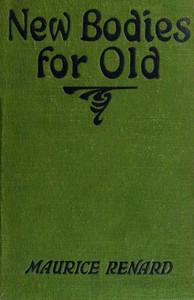
New Bodies for Old — Key Ideas to Explore
(0 User reviews)
1201
Project Gutenberg
2019
Not confirmed
Science fiction, French -- Translations into English
Readers of public-domain and historical texts
Project Gutenberg digital edition
en
Edition facts
Words
68,056
Reading time
296 min
Text sections
20
Before opening New Bodies for Old — Key Ideas to Explore, the edition data offers a quick orientation: 68,056 words, 4 hr 56 min estimated reading time, and 20 detected text sections.
The text analysis averages about 16.3 words per sentence, while the detected sections provide another way to judge how the source is divided.
Project Gutenberg metadata also associates the work with “Science fiction, French -- Translations into English,” connecting these edition facts with the source record’s subject description.
Source:
Project Gutenberg record #59647
Maurice Renard's 1923 novel blends scientific speculation with psychological suspense, narrated by a guest at a country estate who grows suspicious of his uncle's experiments. The text's shifting tone—from convivial dinner banter to tense confrontations—mirrors the narrator's unraveling trust.
Editorial Edition Score
4.8/5
★★★★★
★★★★★
Calculated from edition completeness, EPUB availability, text structure and catalogue metadata. Not a user rating.
How this score is calculated
- Description quality20 pts
- Title & short description10 pts
- Source metadata20 pts
- Text length15 pts
- Chapters / structure15 pts
- EPUB file integrity20 pts
Total of 100 points, scaled to a 2.5-5.0 range. Editions with an empty description or a missing EPUB file are not scored.
Edition quality
Read the complete public-domain text at its original source.
Read on Project GutenbergThe narrative opens not with a laboratory or a monster, but with a dinner party. The unnamed narrator recalls a winter evening in his furnished house on the Avenue Victor Hugo, surrounded by friends who joke and argue. Among them are Gilbert, Marlotte, and Cardaillac—the latter dubbed “our licensed wizard.” This social scene, with its liqueurs and paradoxes, establishes a voice that is urbane, slightly ironic, and fond of cataloguing character types. The tone is light, almost gossipy, before the story shifts to the narrator’s uncle, Professor Lerne, and the mysterious Fonval estate. The contrast between the opening’s convivial chatter and the later, more ominous passages—where Lerne’s honeyed sweetness masks threat—signals a deliberate modulation in narrative pace and mood.
A Narrator Who Watches and Wavers
The narrator’s voice is central to the novel’s effect. In the excerpts, he presents himself as observant but fallible, frequently second-guessing his own judgments. After accusing Lerne of wrongdoing, he immediately doubts himself: “Had I made a mistake, or had Emma lied to me?” This self-questioning creates a sense of uncertainty that permeates the narrative. The reader is never entirely sure whether the narrator is a reliable witness or a paranoid guest. His language shifts from confident assertion to hesitant speculation, as when he thinks, “He is paying court to me now. Look out!” The internal monologue—marked by dashes and exclamations—gives the prose a breathless, almost theatrical quality. This wavering perspective is not a flaw but a deliberate structural choice, keeping the reader aligned with the narrator’s growing unease.
The Weight of a Scar
Among the few concrete details in the excerpts, one stands out: the scar on Donovan, the madman. The narrator notes it is “an incised crown that almost d” (the text cuts off). This scar becomes a focal point of Lerne’s examination, which the narrator suspects is “merely a sham for my benefit.” The scar’s description—partial though it is—hints at a ritualistic or surgical origin, tying into the novel’s title and themes of bodily transformation. The narrator’s attention to this detail, and his suspicion that Lerne is performing a deception, exemplifies how the text uses small, physical clues to build tension. The scar is not explained in the excerpts, but its prominence suggests it will recur as a key piece of evidence in the narrator’s investigation.
Pace and the Art of the Unfinished Sentence
Renard’s prose often accelerates through dialogue and interior monologue, then slows for descriptive or reflective passages. A notable technique is the use of ellipses and abrupt cuts. In the excerpts, sentences trail off: “I cannot remember now exactly [...]” and “the scar—it was an incised crown that almost d”. These breaks mimic the narrator’s fragmented memory or the suppression of horrific details. The pacing also varies between long, winding sentences (as in the dedication to H. G. Wells) and terse, dramatic exchanges: “Obey me, my lad.” / “Ah, he wants to soft-sawder me.” This rhythm keeps the reader off-balance, mirroring the narrator’s own disorientation. The novel’s structure—with chapter titles like “Nocturne” and “The Circeean Operation”—further suggests a deliberate alternation between atmospheric setup and shocking revelation.
Readers approaching New Bodies for Old should attend to the narrator’s voice as an active, shaping force rather than a transparent window onto events. His doubts, his selective attention, and his moments of bravado are all clues to the novel’s deeper concerns with perception and truth. The excerpts offer only a glimpse of the plot, but they reveal a work that is as much about the unreliability of testimony as about scientific hubris. Pay close attention to what the narrator chooses to notice—and what he leaves unfinished.
I’ve often thought about that uneasy evening at the uncle’s estate—how a familiar room grows strange when trust slips. There’s a particular quiet kinship with New Bodies for Old, where every polite sentence carries a tremor. The same subtle shift lives in the way language itself evolves beneath our feet in A Brief History of the English Language and Literature, Vol. 2 — Text and Context, each era’s calm surface hiding its own restless change.
There are no reviews for this eBook.
There are no comments for this eBook.
Reader reflection
Your personal reading reflection
Build a private reading journal entry for this title.
Your progress
0
/
10
2
Did this book hold your interest?
3
Would you encourage someone else to read it?
4
How easy was the book to follow?
5
How clearly were the main ideas presented?
6
How would you rate its originality?
7
Is this a title worth rereading?
8
Would this book work well in a reading group?
9
What changed or sharpened your thinking?
10