
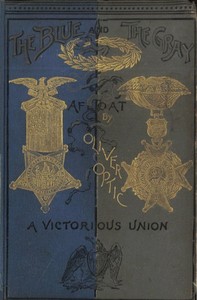
A Victorious Union — Context and Discussion

(1 User reviews)   213
Optic, Oliver, 1822-1897 Project Gutenberg 2006 Not confirmed
United States -- History -- Civil War, 1861-1865 -- Juvenile fiction Readers of public-domain and historical texts
Project Gutenberg digital edition en

Edition facts

Words 72,183
Reading time 314 min
Text sections 10

The source record for A Victorious Union — Context and Discussion measures this digital text at 72,183 words, 5 hr 14 min estimated reading time, and 10 detected text sections.

The text analysis averages about 19.7 words per sentence, while the detected sections provide another way to judge how the source is divided.

Project Gutenberg metadata also associates the work with “United States -- History -- Civil War, 1861-1865 -- Juvenile fiction,” connecting these edition facts with the source record’s subject description.

In the final volume of The Blue and the Gray Series, Union naval officer Christy Passford receives medical care from Confederate surgeon Dr. Davidson, who treats his wound with professional courtesy. The scene highlights mutual respect between enemies, with Captain Rombold praising Christy's bravery and Captain Breaker anxiously overseeing the treatment.
Share
Editorial Edition Score 4.8/5

Calculated from edition completeness, EPUB availability, text structure and catalogue metadata. Not a user rating.

How this score is calculated
  • Description quality20 pts
  • Title & short description10 pts
  • Source metadata20 pts
  • Text length15 pts
  • Chapters / structure15 pts
  • EPUB file integrity20 pts

Total of 100 points, scaled to a 2.5-5.0 range. Editions with an empty description or a missing EPUB file are not scored.

Edition quality

Read the Text

CHAPTER I. The Mission to Mobile Point 15

CHAPTER II. The Departure of the Expedition 26

CHAPTER III. A Bivouac near Fort Morgan 37

CHAPTER IV. The Revelations of the Revellers 48

CHAPTER V. In the Vicinity of the Confederate Fort 59

CHAPTER VI. Captain Sullendine of the West Wind 70

CHAPTER VII. A Powerful Ally of the Belleviters 81

CHAPTER VIII. On Board of the Cotton Schooner 92

CHAPTER IX. The Departure of the Tallahatchie 103

CHAPTER X. The Casting off of the Towline 114

CHAPTER XI. A Happy Return to the Bellevite 125

CHAPTER XII. A Lively Chase to the South-West 136

CHAPTER XIII. The First Shot of Blumenhoff 147

CHAPTER XIV. The Progress of the Action 158

CHAPTER XV. A Flank Movement Undertaken 169

CHAPTER XVI. The Lieutenant's Daring Exploit 180

CHAPTER XVII. A Magnanimous Enemy 191

CHAPTER XVIII. The Reign of Christianity 202

CHAPTER XIX. Colonel Homer Passford of Glenfield 213

CHAPTER XX. A Very Melancholy Confederate 224

CHAPTER XXI. Captain Sullendine Becomes Violent 225

CHAPTER XXII. The Disposition of the Two Prizes 246

CHAPTER XXIII. The Welcome Home at Bonnydale 257

CHAPTER XXIV. Lieutenant-Commander Christopher Passford 268

CHAPTER XXV. The Principal Officers of the St. Regis 279

CHAPTER XXVI. The St. Regis in Commission 290

CHAPTER XXVII. Captain Passford Alone in his Glory 301

CHAPTER XXVIII. Off the Coast of North Carolina 312

CHAPTER XXIX. The First Prize of the St. Regis 323

CHAPTER XXX. Another Sailing Contest Inaugurated 334

CHAPTER XXXI. A Victorious Union 345

THE MISSION TO MOBILE POINT

"I almost wish you were the second or the third lieutenant of the Bellevite, instead of the executive officer, Christy," said Captain Breaker, the commander of the steamer, as they were seated together one day on the quarter-deck.

"Do I fail in the discharge of my duty in my present position, Captain?" asked Christy, very much astonished, not to say startled, at the remark of the commander.

"Not in the slightest degree, my dear boy!" returned Captain Breaker with very decided emphasis. "You have served in your present capacity for four months; and if you were fifty years old, and had twenty years of naval experience behind you, it would be hardly possible for you to be more correct and dignified in the performance of the details of your office."

"I thank you, Captain, for the partial view you take of what I have done," added Christy, taking off his cap and bowing to his superior.

"Well, you ought to be a good officer in any situation, my dear fellow," continued the commander. "I doubt if there is another officer in the navy who has enjoyed the advantages you have had in preparing himself for the duties of his profession. You were brought up, so to say, on board of the Bellevite. You were a good scholar in the first place. Without including myself, you have had excellent teachers in every department of science and philosophy, among whom your father was one of the wisest. Poor Dashington was one of the best seamen that ever trod a deck; and he took especial delight in showing you how to make every knot and splice, as well as in instructing you in the higher details of practical seamanship. Blowitt and myself assisted him, and old Boxie, who gave his life to his country, was more than a grandfather to you."

"I have certainly been very grateful to you and to them for all they did for me," replied Christy with a sad expression on his handsome face as the commander recalled the three shipmates of both of them who slept in heroes' graves.

"Perhaps the brilliant genius of our engine-room did quite as much for you as any other person, though not many years your senior."

"Paul Vapoor is my friend and crony; and if he had been my professor in a college he could have done no more for me. I assure you, Captain, that I keep alive my gratitude to all my instructors, including some you have not mentioned."

"I was only explaining why you are what you ought to be, for you have had very exceptional opportunities, better by far than any other officer in the service. But it is altogether to your credit that you have used those opportunities wisely and well."

"I should have been a blockhead if I had not."

"That is very true; but the mournful wrecks of wasted opportunities strew the tracks of many, many young men. I think you can look back upon as few of them as any one within my knowledge," said the commander, bestowing a look of genuine affection upon his chief officer. "More than once, even before we entered upon this terrible war, I have told your father how happy he ought to be in having such a son as you are."

"Come, come, Captain Breaker, you are praising me!" exclaimed Christy impatiently.

"I am speaking only the simple truth, and I have very rarely said as much as I say now. It was when you asked me if you had failed in the discharge of the duties of your present position that I was led into this line of remark; and I am sure you will not be spoiled by honest and just praise," replied the captain.

"Then, to go back to the point where you began, why do you almost wish that I were second or third lieutenant, instead of executive officer, of the Bellevite, Captain?" continued Christy, rising from his seat, and fixing an earnest gaze upon the face of the commander, for he was very sensitive, and he could not help feeling that he had been lacking in something that would make him a better executive officer than he was.

"Mr. Ballard, the second lieutenant, and Mr. Walbrook, the third, are gentlemen of the highest grade, and excellent officers; but they are both somewhat wanting in dash and cool impetuosity."

"'Cool impetuosity' is very good, Captain," added Christy with a laugh.

"But that is precisely what I mean, my boy, and no two words could express the idea any better. You cannot carry an enemy by boarding with the same precision you man the yards on a ceremonious occasion, or as a regiment of soldiers go on dress parade. It requires vim, dash, spirit. The officers named have this quality in a very considerable degree, yet not enough of it. But what they lack more is ingenuity, fertility in expedients, and the expansive view which enables them to take advantage promptly of circumstances. You never lose your head, Christy."

"I never knew the gentlemen named to lose their heads, and I have always regarded them as model officers," replied the first lieutenant.

"And so they are: you are quite right, my dear boy; but it is possible for them to be all you say, and yet, like the young man of great possessions in the Scripture, to lack one thing. I should not dare to exchange my second and third lieutenants for any others if I had the opportunity."

"I confess that I do not understand you yet, Captain."

The commander rose from his seat, stretched himself, and then looked about the deck. Taking his camp-stool in his hand he carried it over to the port side of the quarter-deck, and planted it close to the bulwarks. The second lieutenant was the officer of the deck, and was pacing the planks on the starboard side, while the lookouts in the foretop and on the top-gallant forecastle were attending closely to their duty, doubtless with a vision of more prize money floating through their brains.

The Bellevite, with the fires banked in the furnaces, was at anchor off the entrance to Mobile Bay, about two miles east of Sand Island Lighthouse, and the same distance south of the narrow neck of land on the western extremity of which Fort Morgan is located. Her commander had chosen this position for a purpose; for several weeks before, while the Bellevite was absent on a special mission, a remarkably fast steamer called the Trafalgar had run the blockade inward.

Captain Passford, Senior, through his agents in England, had some information in regard to this vessel, which he had sent to Captain Breaker. Unlike most of the blockade-runners built for this particular service, she had been constructed in the most substantial manner for an English millionaire, who had insisted that she should be built as strong as the best of steel could make her, for he intended to make a voyage around the world in her.

Unfortunately for the owner of the Trafalgar, who was a lineal descendant of a titled commander in that great naval battle, he fell from his horse in a fox chase, and was killed before the steamer was fully completed. His heir had no taste for the sea, and the steamer was sold at a price far beyond her cost; and the purchaser had succeeded in getting her into Mobile Bay with a valuable cargo. She was of about eight hundred tons burden, and it was said that she could steam twenty knots an hour. She was believed to be the equal of the Alabama and the Shenandoah. The Bellevite had been especially notified not to allow the Trafalgar to escape. She had recently had her bottom cleaned, and her engine put in perfect order for the service expected of her, for she was the fastest vessel on the blockade.

When Captain Breaker had assured himself that he was out of hearing of the officer of the deck, he invited Christy to take a seat at his side. He spoke in a low tone, and was especially careful that no officer should hear him.

"Perhaps I meddle with what does not concern me, Christy; but I cannot help having ideas of my own," said the commander, when he was satisfied that no one but the executive officer could hear him. "There is Fort Morgan, with Fort Gaines three miles from it on the other side of the channel. Mobile Point, as it is called at this end of the neck, extends many miles to the eastward. It is less than two miles wide where it is broadest, and not over a quarter of a mile near Pilot Town."

"I have studied the lay of the land very carefully, for I have had some ideas of my own," added Christy, as the commander paused.

"If Fort Morgan had been Fort Sumter, with bad memories clinging to it, an effort would have been made to capture it, either by bombardment by the navy, or by regular approaches on the part of the army," continued Captain Breaker. "They are still pounding away at Fort Sumter, because there would be a moral in its capture and the reduction of Charleston, for the war began there. Such an event would send a wave of rejoicing through the North, though it would be of less real consequence than the opening of Mobile Bay and the cleaning out of the city of Mobile. Except Wilmington, it is the most pestilent resort for blockade-runners on the entire coast."

"Then you think Fort Morgan can be reduced from the land side?" asked Christy, deeply interested in the conversation.

"I have little doubt of it; and while I believe Farragut will resort to his favorite plan of running by the forts here, as he has done by those of the Mississippi, the army will be planted in the rear of both these forts. As we have lain here for months, I have studied the situation, and I want to know something more about the land on the east of Mobile Point."

"I should say that it would be easy enough to obtain all the information you desire in regard to it," suggested Christy.

"There is an unwritten tradition that the commander must not leave his ship to engage in any duty of an active character, and I cannot explore the vicinity of the fort myself."

"But you have plenty of officers for such duty."

"I have no doubt there are pickets, and perhaps a camp beyond the rising ground, and the exploration would be difficult and dangerous. The two officers I have mentioned before lack the dash and ingenuity such an enterprise requires; and a blunder might involve me in difficulty, for I have no orders to obtain the information I desire."

"The officers named are prudent men within reasonable limits."

"They are; but I would give up my idea rather than trust either of them with this duty," replied Captain Breaker very decidedly. "But I have a further and nearer object in this exploration; in fact, examining the ground would be only secondary."

"What is the real object, Captain?" asked the first lieutenant, his curiosity fully awakened.

"I feel that it will be necessary to use extraordinary efforts to capture the Trafalgar, for no steamer of her alleged speed has ever run into or out of Mobile Bay. After I informed the flag-officer in regard to her, which your father's information enabled me to do, the Bellevite was especially charged with the duty of capturing her, if she had to chase her all over the world."

"I have not much doubt that you will do it, Captain."

"I mean to do so if possible. Now these blockade-runners usually anchor near the lower fleet, or under the guns of the fort in five fathoms of water. Sometimes they remain there two or three days, waiting for a favorable opportunity to run out. Perhaps the Trafalgar is there now. I wish to know about it."

"I infer that you consider me fitted for this duty, Captain Breaker," said Christy earnestly.

"For that reason only I almost wished you were second or third lieutenant, rather than first," replied the commander with some earnestness in his manner.

There was no unwritten tradition that the first lieutenant should not be sent on any duty.

THE DEPARTURE OF THE EXPEDITION

The conversation between the captain and the executive officer of the Bellevite was continued till they were called to supper; but a decision had been reached. On important occasions, as when several boats were ordered upon an expedition, it was not unusual to send the first lieutenant in command. Though only a single whaleboat would be required for the enterprise in which the commander was so deeply interested, its importance appeared to justify the selection of the executive officer to conduct it; and Christy was directed to suit himself.

Of course the expedition was to be sent out at night, for the cover of the darkness was necessary to render it effectual. In the afternoon the wind had come around to the south-west, and already a slight fog had obscured the Sand Island Lighthouse. It promised to be such a night as a blockade-runner would select for getting to sea.

Christy was especially warned that the principal business of his expedition was to obtain information in regard to the Trafalgar, though it was probable that a new name had been given to her for the service in which she was to be engaged. The examination of the surroundings of the fort, the captain strongly impressed upon his mind, was entirely subsidiary to the discovery of the intending blockade-runner. In fact, the commander seemed to have serious doubts as to whether it was proper for him even to reconnoitre without special orders for the use of the army.

It was several months that Christy had been on board of the Bellevite in his present capacity, and he had become very well acquainted with all the petty officers and seamen of the ship's company, now composed of one hundred and twenty men. After he had finished his supper he walked about the spar-deck to refresh his memory by a sight at all of the men, and selected those who were to take part in his enterprise.

One of the first persons he encountered in his promenade was the third assistant engineer, Charles Graines, whom he had known as a boy, before the war. He was not only a machinist, but a sailor, having served in both capacities, though now only twenty-five years of age. Through his father Christy had procured his appointment as an engineer, and his assignment to the Bellevite. The young man was exceedingly grateful to him for this service, and entirely devoted to him.

Paul Vapoor, the chief engineer, spoke of Graines in the highest terms, not only in his official capacity, but as a high-toned, patriotic, and thoroughly reliable man. The moment the executive officer put his eye on the assistant engineer, he decided that Graines should be his right-hand man. As a matter of precaution the proposed expedition was to be a profound secret, for there were white men and negroes about the deck who had been picked up in various ways, and were retained till they could be disposed of. They could not be trusted, and doubtless some of them were Confederates at heart, if not engaged in secret missions.

Christy invited Graines to the ward room for a conference. There were several officers there, and they retired to the stateroom of the first lieutenant, which is the forward one on the starboard side. The plan, as it had been matured in the mind of the one appointed to carry it out, was fully explained, and the engineer was delighted to be chosen to take part in its execution. The selection of the seamen to compose the expedition was not an easy matter, though every sailor on board would have volunteered for such duty if the opportunity had been presented to him.

Graines was not so familiar with the merits of the seamen as he was with those of the men in the engineer department. It became necessary for the executive officer to take another walk on the spar-deck, in order to revive his recollection of the men; and he soon returned to the stateroom with a complete list of those he had selected. The engineer suggested an oiler by the name of Weeks as a most excellent man; and Christy accepted him, completing the number from those of his own choice. Seated at his desk, he wrote out the names of the ten men chosen.

"Of course if we should be caught on shore in our ordinary uniforms it would be all night with us," said Christy, as he completed the writing out of the list. "I believe you have never seen the inside of a Confederate prison, Mr. Graines."

"Never; though I came pretty near it once while I was an oiler on board of the Hatteras," replied the engineer.

"You have been fortunate, and I hope you will come out of this excursion as well. I spent a short time in a Confederate lock-up; but I did not like the arrangements, and I took leave of it one night. It was in Mobile, and I don't care to be sent up there again. Therefore we must clothe ourselves in the worst garments we can find; and I carry a suit for just this purpose, though I have not had occasion to use it lately."

"I have to wear old clothes when at work on the machinery, and I have a plentiful supply on hand," added Graines. "Perhaps I could help out some of the others."

"All the seamen have old clothes, and they will need no assistance in arranging their wardrobes. Now, Mr. Graines, it will excite remark if I instruct the ten men we have selected, and I must leave that part of the work to you," continued Christy. "But all the instruction you need give them is in regard to their dress, and require them to be at the main chains on the starboard side at ten o'clock to-night precisely."

"As I have plenty of time I will take the men, one at a time, to my room in the steerage, and instruct them," replied the engineer.

"You can tell each one to send in the next one wanted. Above all, make them promise not to speak to any person whatever in regard to the expedition," said the executive officer as his companion retired.

Mr. Graines lost no time in discharging the important duty assigned to him. Christy reported to the commander, as soon as he found an opportunity to speak to him privately, what progress he had made in carrying out the duty assigned to him. Captain Breaker looked over the list of the men selected, and gave it his hearty approbation. He was a man of elevated moral and religious character; he had always exercised a sort of fatherly supervision over his ship's company, and he was better acquainted with those under his command than most commanders.

"It looks as though it was going to be a good night for blockade-runners, Mr. Passford," said Captain Breaker, as he looked over to windward and saw the banks of fog, not yet very dense, rolling up from the open gulf.

In A Victorious Union, the sixth and final volume of Oliver Optic's The Blue and the Gray Series, the narrative focuses on the closing phase of the Civil War at sea. The excerpts reveal a scene where Union lieutenant Christy Passford, wounded in action, is treated by the Confederate surgeon Dr. Davidson aboard a captured vessel. The episode emphasizes professional courtesy and personal honor between adversaries, as both commanders—Captain Breaker of the Union and Captain Rombold of the Confederacy—express admiration for each other's character. The catalog subject "United States -- History -- Civil War, 1861-1865 -- Juvenile fiction" aligns with the naval setting and patriotic tone, but the excerpts show that the book's emphasis is less on battle tactics and more on gentlemanly conduct and interpersonal dynamics among officers.

Medical Care Across Enemy Lines

The excerpt centers on the dressing of Christy Passford's wound by Dr. Davidson, a Confederate surgeon. The dialogue reveals a striking absence of hostility in the medical encounter. Dr. Davidson remarks that the wound was "too long neglected" and that Christy would have recovered sooner had he sought treatment immediately after the action. This detail suggests that Christy's pride or sense of duty caused him to delay care, a character trait consistent with the series' portrayal of young officers. The Confederate surgeon's professionalism is underscored when he invites Dr. Linscott, the Union surgeon, to examine the wound, saying "I should be happy to have you examine his injury." This cooperative spirit contrasts with the war context, illustrating a code of conduct that transcends allegiance.

The Language of Respect Between Commanders

Captain Rombold, the Confederate commander, speaks of Christy with admiration: "He is a gentleman in every sense of the word, and the bravest of the brave. It was he who defeated my scheme; but I admire and respect him." This statement, made to his own surgeon, reveals that Rombold values personal honor over military defeat. Similarly, Captain Breaker's anxious arrival and tender address to Christy—"I did not know that you were wounded, my dear boy"—shows a paternal bond between the Union captain and his executive officer. The two commanders, meeting for the first time, are introduced by Christy and shake hands politely. The text describes them as "both brave and noble men," reinforcing the theme of mutual respect that runs through the scene.

Narrative Structure and Series Context

The preface states that A Victorious Union is "the sixth and last of 'The Blue and the Gray Series.'" It notes that the incidents "accurately conform to the facts, and especially to the spirit, of the eventful years." However, the excerpts do not provide a connected historical narrative; instead, they focus on a single interpersonal episode. The dedication to Frank L. Harris, a naval officer who served in both the Arctic and the Civil War, suggests that Optic drew on real naval experience for authenticity. The book's place as a series finale implies that Christy Passford's story reaches a conclusion, but the excerpts alone do not reveal the outcome of the war or his personal fate. Readers familiar with earlier volumes will find continuity in the character relationships and the emphasis on moral character.

The excerpts from A Victorious Union offer a focused view of naval conduct during the Civil War, emphasizing courtesy and professionalism over combat. Readers approaching this as the series finale should expect a resolution centered on character rather than large-scale battles. The medical scene and the interactions between officers provide a lens into the values Optic sought to instill in his young audience: bravery, humility, and respect for opponents. Those new to the series may find the dialogue-driven style and moral clarity representative of 19th-century juvenile fiction.

There is a quiet knot in war stories—the moment an enemy surgeon tends your wound, as Davidson does for Christy, and honor outlasts the uniform. It reminds me of another sort of clasp: Roderick Hudson's restless seeking against a friend's steadying watch. Both books hold that tender tension, where opposition becomes attachment, and I find myself smiling at their shared, unspoken kinship. Roderick Hudson — Text and Context keeps that same pulse.

Sofia Flores
1 month ago

4
4 out of 5 (1 User reviews )

Add a Review

Your Rating *
There are no comments for this eBook.

Reader reflection

How will you remember this book?

Save your reaction, strongest insight, and memorable passage.

Your progress 0 / 10
1

Have you finished this book?

2

How much did you enjoy the reading experience?

3

Is this a title you would suggest to others?

4

How demanding did the text feel?

Related eBooks